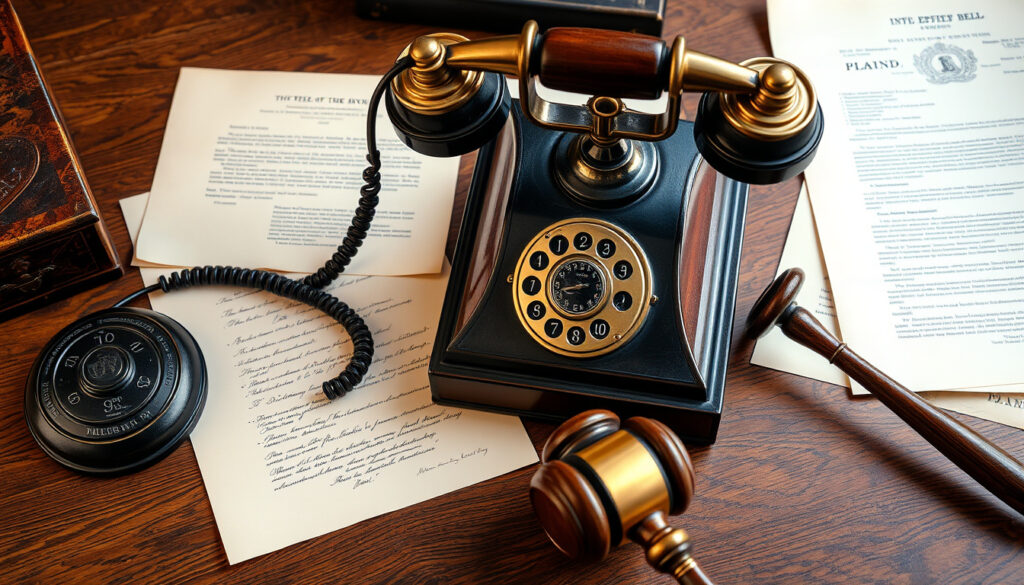
Alexander Graham Bell: The Telephone, the Controversy & His Legacy
It’s a name practically everyone recognizes, but the full story behind Alexander Graham Bell’s telephone is far messier than the schoolbook version suggests. Between a frantic patent race, forgotten inventors, and a lifelong devotion to teaching the deaf, the man who gave us the telephone was a bundle of contradictions. Here’s what really happened — and why the debate over who invented the telephone still simmers today.
Born: March 3, 1847, Edinburgh, Scotland ·
Died: August 2, 1922, Beinn Bhreagh, Canada ·
Most famous for: Patent for the first practical telephone (1876) ·
Known patents: 18 granted in his name alone ·
Other notable work: Invention of the photophone and the metal detector ·
Occupation: Inventor, scientist, engineer, teacher of the deaf
Quick snapshot
- Patented the first practical telephone on March 7, 1876 (Britannica)
- Held 18 patents in his name (SoftSchools)
- Inducted into the National Inventors Hall of Fame (Britannica)
- Whether Elisha Gray filed a similar caveat hours before Bell’s patent (Linda Hall Library)
- How much Antonio Meucci’s earlier prototype influenced Bell’s design (Linda Hall Library)
- Patent filed March 7, 1876; first successful call three days later (Britannica)
- Bell Telephone Company formed July 1877 (Britannica)
- Ongoing historical reevaluation of Bell’s role amid claims by Gray and Meucci (Linda Hall Library)
- Growing focus on Bell’s complex legacy in deaf education and eugenics (Linda Hall Library)
The following table summarizes key biographical data about Alexander Graham Bell.
| Attribute | Detail |
|---|---|
| Full name | Alexander Graham Bell |
| Born | March 3, 1847, Edinburgh, Scotland (Britannica) |
| Died | August 2, 1922, Beinn Bhreagh, Nova Scotia |
| Telephone patent | U.S. Patent No. 174,465, granted March 7, 1876 |
| First telephone call | March 10, 1876 — “Mr. Watson, come here, I want to see you” (Britannica) |
| Number of patents | 18 granted in his name alone (SoftSchools) |
| Other inventions | Photophone (wireless optical communication), metal detector, early aircraft |
| Occupation | Inventor, scientist, engineer, teacher of the deaf |
| Spouse | Mabel Hubbard (m. 1877), who was deaf (Heritage History) |
| Induction | National Inventors Hall of Fame |
What is Alexander Graham Bell most known for?
The invention of the first practical telephone
- On March 7, 1876, Bell received U.S. Patent No. 174,465 for “improvements in telegraphy” — the patent that covered the telephone (Britannica).
- Three days later, he made the first successful transmission of speech: “Mr. Watson, come here, I want to see you.”
- The Bell Telephone Company was founded in July 1877, with Gardiner Hubbard as its head (Britannica).
Bell’s patent became the most valuable single patent in history, laying the foundation for AT&T and the global telecommunications industry. But its validity was challenged repeatedly.
The controversy stems from the fact that Elisha Gray filed a caveat — a preliminary notice of invention — for a voice-transmission device on the very same day, February 14, 1876 (Linda Hall Library). Who arrived first at the patent office has been debated ever since.
The implication: Bell’s patent race and deaf education combined to make him a transformative figure, albeit a contested one.
His work with the deaf and speech therapy
- Bell’s mother, Eliza Symonds, lost her hearing due to illness, which sparked his lifelong interest in speech and sound (Linda Hall Library).
- His father, Alexander Melville Bell, invented “Visible Speech,” a system of symbols to teach the deaf to speak (SoftSchools).
- At age 12, Bell created his first invention — a wheat-cleaning machine — but his real passion was teaching the deaf (SoftSchools).
- He taught at the American School for the Deaf in Boston, where he met his future wife, Mabel Hubbard, who was deaf and had been his pupil (Britannica).
What this means: Bell’s telephone was not born from abstract tinkering — it came from decades of thinking about how sound vibrations could be visualized and transmitted. His work with the deaf gave him the empathy and the technical insight to solve voice transmission.
The National Inventors Hall of Fame recognition
- Bell was inducted into the National Inventors Hall of Fame in 1974, a posthumous acknowledgment of his transformative contribution to communication.
- He shares the Hall with other titans like Thomas Edison and Nikola Tesla — but the controversy over who really invented the telephone has shadowed his induction.
The trade-off: Bell’s Hall of Fame status is secure, but the persistent claims of Gray and Meucci mean his legacy is more contested than most genius inventors.
Who was the real inventor of the telephone?
Elisha Gray’s caveat and the patent race
- On February 14, 1876, Elisha Gray filed a caveat at the U.S. Patent Office describing a telephone-like device. Bell’s full patent application was filed the same day (Linda Hall Library).
- There are allegations that a patent examiner may have shown Bell details of Gray’s caveat before approving Bell’s patent. No direct evidence has been proven, but the suspicion persists.
The timeline of the patent race is shown below.
| Inventor | Key event | Date |
|---|---|---|
| Elisha Gray | Filed caveat for voice transmission device | February 14, 1876 |
| Alexander Graham Bell | Filed patent for telephone | February 14, 1876 |
| Bell | Patent granted (No. 174,465) | March 7, 1876 |
| Bell | First successful call | March 10, 1876 |
The pattern: both men filed on the same day, but Bell’s patent was granted first. The race was so close that if Gray had filed his caveat hours earlier, the entire history of telephony might have flipped.
Antonio Meucci’s earlier work
- Italian immigrant Antonio Meucci developed a voice-communication device he called the “telettrofono” as early as 1854, more than two decades before Bell (Linda Hall Library).
- Meucci filed a caveat in 1871 but could not afford the full patent fee. His model was lost when his lab burned down.
- In 2002, the U.S. House of Representatives recognized Meucci’s contributions, stating that “the contributions of Antonio Meucci to the invention of the telephone should be acknowledged” — though the resolution stopped short of naming him the inventor.
The catch: Meucci had the idea first, but he lacked the resources to commercialize it. Bell, with backing from investors like Gardiner Hubbard, turned the concept into a working business. Priority in invention is legally about filing, not first thought.
The US House of Representatives resolution (2002)
- House Resolution 269, passed in 2002, expressed “the sense of the House of Representatives that the life and achievements of Antonio Meucci should be recognized, and his work in the invention of the telephone should be acknowledged.”
- It did not declare Meucci the inventor, and the resolution is symbolic — it does not change the patent record.
“The contributions of Antonio Meucci to the invention of the telephone should be acknowledged.” — U.S. House of Representatives, 2002
Why this matters: The resolution was a moral recognition, not a legal one. It shows that even the U.S. government, which granted Bell’s patent, acknowledges his work may have been built on prior inspiration.
The pattern: The legal and historical lines diverge, leaving a permanent gap in how we remember the telephone’s origin.
Did Alexander Graham Bell invent the telephone?
The scope of Bell’s patent
- Bell’s patent No. 174,465 covered “the method of, and apparatus for, transmitting vocal or other sounds telegraphically.” It was broad enough to encompass the entire concept of voice telephony.
- It was called the “most valuable patent in history” because it controlled the entire telephone industry until the early 1900s.
The implication: Bell’s patent gave him a legal monopoly. But a patent does not prove he was the first to create a working device — it proves he was the first to secure a valid patent for it.
Legal disputes and court rulings
- Bell faced more than 600 lawsuits challenging his patent. The U.S. Supreme Court upheld the patent in multiple cases, citing Bell’s successful demonstration and clear specification.
- Litigation included challenges by Western Union (backing Gray) and numerous independent inventors. Bell’s legal and financial team, led by Hubbard, won every major case.
The pattern: The courts consistently ruled in Bell’s favor, but the shadow of impropriety — the possible patent office leak — kept the controversy alive.
Modern consensus
- Most historians and science museums credit Bell as the inventor of the telephone as a practical, marketable device. The Smithsonian Institution and Britannica both list Bell as the inventor.
- However, they also acknowledge Gray’s caveat and Meucci’s earlier work, placing Bell’s achievement in a continuum of innovation rather than a single eureka moment.
The trade-off: Bell is the face of the telephone, but history increasingly sees him as the one who finished the race, not the one who started it.
What are 5 facts about Alexander Graham Bell?
Early life and family of speech therapists
- Bell was born on March 3, 1847, in Edinburgh, Scotland, as “Alexander Bell.” He adopted the middle name “Graham” at age 10 (Texas Government disability history).
- His father and grandfather were elocutionists. His mother was deaf. His wife, Mabel, was deaf. Sound and silence shaped his entire life.
Move to Canada and the United States
- After his brothers died of tuberculosis, the Bell family moved to Ontario, Canada, in 1870 (Britannica).
- Bell then taught in Boston, Massachusetts, at the American School for the Deaf, where he met Mabel Hubbard.
Inventions beyond the telephone
- Bell invented the photophone, which transmitted sound on a beam of light — a precursor to fiber-optic communication (Linda Hall Library).
- He also developed a metal detector to locate bullets in President James Garfield’s body, and worked on early aircraft (the Silver Dart flew in 1909).
- He received 18 patents in total, spanning telephony, aviation, and optical communication.
Bell’s mind never stopped at the telephone. His photophone and metal detector show a restless inventor who explored light and magnetism as tools for communication, decades before the rest of the world caught up.
The catch: Bell’s lesser-known inventions reveal a mind that thought beyond wiring, yet most of those ideas remained decades ahead of their time.
Why did Alexander Graham Bell invent the telephone?
Motivation from his work with the deaf
- Bell’s primary motivation was to improve communication for the deaf. He wanted to help people like his mother and wife to speak and hear better (Linda Hall Library).
- He believed that visible speech and voice transmission could bridge the gap between hearing and deaf worlds.
Inspiration from harmonic telegraph experiments
- While working on a harmonic telegraph (a device to send multiple telegraph messages on one wire), Bell accidentally discovered that a reed could transmit voice sounds.
- He wrote in his notebook: “If I can make a current of electricity vary in intensity precisely as the air varies in density during the production of sound, I can transmit speech telegraphically.”
Commercial goals and financial backing
- Gardiner Hubbard and Thomas Sanders funded Bell’s experiments in exchange for a share of future profits (Britannica).
- Hubbard, the father of Bell’s future wife, saw the commercial potential and pushed Bell to file patents quickly — setting the stage for the race with Gray.
“Mr. Watson, come here, I want to see you.” — Alexander Graham Bell, first telephone call, March 10, 1876 (Britannica)
The implication: Bell’s invention was a perfect storm. Deep understanding of sound, a desire to help the deaf, investor pressure, and a lucky breakthrough all converged.
The pattern: The telephone was not an isolated brainstorm; it emerged directly from Bell’s mission to make speech accessible to the deaf.
A timeline of Bell’s life and the telephone patent race
- March 3, 1847: Born in Edinburgh, Scotland (Britannica)
- 1859: First invention: a wheat-cleaning machine (SoftSchools)
- 1870: Family moves to Ontario, Canada (Britannica)
- 1873: Begins teaching at the American School for the Deaf, Boston; meets Mabel Hubbard (Britannica)
- February 14, 1876: Gray files caveat; Bell files patent application (Linda Hall Library)
- March 7, 1876: Bell’s patent granted (Britannica)
- March 10, 1876: First successful telephone call (Britannica)
- July 1877: Bell Telephone Company founded (Britannica)
- August 2, 1922: Bell dies at Beinn Bhreagh, Canada (Britannica)
The pattern: the patent race compressed into three days in March 1876 changed the world. Everything before led to that moment; everything after built on it.
Confirmed facts
- Bell patented the first practical telephone on March 7, 1876 (Britannica)
- He made the first intelligible telephone call on March 10, 1876 (Britannica)
- He held 18 patents (SoftSchools)
- He taught the deaf and his wife and mother were deaf (Linda Hall Library)
- The Bell Telephone Company became AT&T (Britannica)
What’s uncertain
- Whether Bell saw Gray’s caveat before filing his patent
- Whether Meucci could have built a working telephone with funding
- The exact timeline of Gray’s caveat filing (morning vs. afternoon)
- Whether Bell’s eugenics views undermine his legacy as a humanitarian
- Whether Bell’s patent was influenced by prior art from Gray and Meucci
Many historians argue that Elisha Gray filed a caveat on the same day, fueling a controversy that overshadows the true story behind the telephone invention.
Frequently asked questions
What is Alexander Graham Bell’s most famous invention?
He is most known for patenting the first practical telephone in 1876 and founding the Bell Telephone Company (later AT&T). He also invented the photophone and made significant contributions to deaf education.
Who is legally considered the inventor of the telephone?
The legal answer is Alexander Graham Bell, who was granted the patent. However, Elisha Gray filed a caveat on the same day, and Antonio Meucci had earlier prototypes. The U.S. House of Representatives acknowledged Meucci’s contributions in 2002.
Did Alexander Graham Bell actually invent the first working telephone?
Bell invented and patented the first working telephone that could transmit intelligible speech. He also commercialized it. But he was not the only person working on voice transmission at the time.
What are some lesser-known facts about Alexander Graham Bell?
1. Born in Edinburgh, Scotland on March 3, 1847. 2. His mother and wife were deaf. 3. He invented the photophone (optical communication). 4. He held 18 patents. 5. He made the first telephone call saying “Mr. Watson, come here, I want to see you.”
What are three of Alexander Graham Bell’s inventions?
The telephone (1876), the photophone (1880, wireless voice transmission via light), and the metal detector (1881).
Who said hello first in a telephone?
Thomas Edison suggested “hello” as a telephone greeting. Bell preferred “ahoy.” The first telephone call began with “Mr. Watson, come here, I want to see you.”
What were Alexander Graham Bell’s last words?
Accounts vary, but it is said his last words were to his wife, expressing his love. No definitive record exists.
What were Alexander Graham Bell’s primary motivations for inventing the telephone?
His primary motivation was to improve communication for the deaf. He wanted to make speech visible and transmittable. Commercial backing from Gardiner Hubbard also played a key role.
Related reading: Hard Words to Spell: 50+ Tricky Words and Memory Tricks · How Many Languages in the World? 7,170+ Facts & Lists
More related posts
 Jack Black: Biography, Family, Net Worth, and Political Views
 The Rock Weight Loss: Inside Dwayne Johnson’s Body Transformations
 Should You Pop a Blister? Expert Advice & Safe Drainage Steps
 FC Barcelona vs Rayo Vallecano Stats: Possession & xG
 Sophia Laforteza: Age, Nationality, KATSEYE Leader Facts
 Alan Ritchson Movies and TV Shows: Reacher, TMNT & More
 Cute Pictures: Find, Draw, and Use Adorable Images
 Short French Tip Nails: Chic Ideas for Every Length