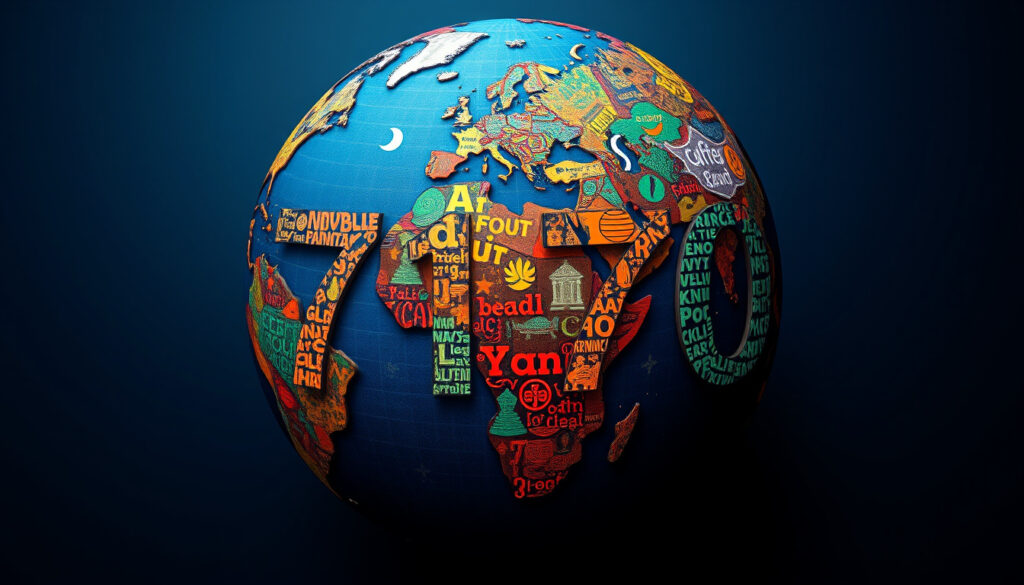
How Many Languages in the World? 7,170+ Facts & Lists
If you ask most people to guess how many languages exist worldwide, you’ll get answers ranging from a few hundred to a few thousand. The actual number sits around 7,170 — a figure that shifts slightly each year as linguists revise their counts. Ethnologue, the most widely referenced authority on world languages, maintains this rolling tally, and the story behind that number is more dynamic than most realize.
Total living languages: 7,170 · Most spoken language: Mandarin Chinese · Languages at risk: over 40% endangered · ISO standards: over 7,100
Quick snapshot
- Ethnologue’s 27th edition (2024) lists 7,164 living languages (Wikipedia Ethnologue article)
- The count dropped by 4 from the 26th edition’s 7,168 (Wikipedia Ethnologue article)
- That number changes yearly as knowledge improves (Wikipedia Ethnologue article)
- Precise daily language extinction rate
- Exact oldest spoken language (debated among linguists)
- Glottolog counts ~7,900 — nearly 700 more than Ethnologue
- 1984: 5,445 languages (10th edition)
- 2007: Switched to ISO 639-3 standard
- 2024: 7,164 languages (27th edition)
- 40%+ of languages are endangered
- UNESCO tracks 2,473 at risk of vanishing
- Documentary work continues via SIL International
The table below consolidates key global language statistics from authoritative sources.
| Metric | Value |
|---|---|
| Total languages (Ethnologue 27th) | 7,164 |
| Endangered languages | 40%+ |
| Most languages country | Papua New Guinea (840+) |
| Second most languages | Indonesia (710+) |
| Oldest written record | Sumerian (~3100 BC) |
| Global population | 7.683 billion |
Are there over 7,000 languages in the world?
Yes — and the count has hovered above 7,000 for nearly two decades. Ethnologue’s 27th edition, published in 2024, lists 7,164 living languages in use worldwide. The number dipped by four from the previous year’s 7,168, a fluctuation that reflects ongoing changes in classification rather than actual language loss.
This total represents languages currently spoken somewhere on the planet, from Mandarin Chinese with over a billion native speakers down to languages with only a handful of elderly speakers. The count is fluid because linguists constantly revise their understanding of what constitutes a separate language versus a dialect of the same tongue.
Current Ethnologue count
Ethnologue, published by SIL International, serves as the primary reference for global language statistics. Their homepage currently states Ethnologue official website 7,170 languages are in use today — slightly higher than the 27th edition’s 7,164, reflecting ongoing updates.
The publication has grown dramatically over its history: from 5,445 languages in the 10th edition (1984) to 6,909 by the 16th edition (2009). This increase partly reflects improved fieldwork but also political decisions — governments sometimes push for recognition of regional varieties as distinct languages to qualify for translation funding.
Factors causing flux in numbers
Changes between editions stem from several sources. When five languages were dropped in the 24th edition — one declared extinct, four merged with other varieties — 27 were simultaneously added. The ISO 639-3 standard, adopted in 2007, governs classification decisions, giving linguists a common framework while leaving room for interpretation.
We are discovering languages faster than they are disappearing — but not fast enough to preserve them all. The number of documented languages keeps rising even as some face extinction.
What are the top 5 spoken languages in the world?
The five most spoken languages by native speakers are Mandarin Chinese, Spanish, English, Hindi, and Arabic. Mandarin alone accounts for roughly 1.1 billion native speakers, making it the world’s most widely spoken native language by a significant margin.
By native speakers
These five languages dominate global communication, but they do not represent an even distribution. Chinese dialects are often grouped under “Mandarin” for political reasons that linguists debate, while Arabic varieties span a continuum from Morocco to Iraq that few consider mutually intelligible.
- Mandarin Chinese: ~1.1 billion native speakers
- Spanish: ~559 million native speakers
- English: ~502 million native speakers
- Hindi: ~602 million native speakers
- Arabic: ~402 million native speakers
By total speakers (including second language)
When second-language speakers are included, the rankings shift. English climbs to the top, spoken fluently by roughly 1.5 billion people worldwide, followed by Mandarin Chinese and Hindi. The Ethnologue 200 — the top 200 most spoken languages — accounts for 88% of the global population.
Which countries have the most languages?
Papua New Guinea leads the world with over 800 languages spoken across a landmass smaller than Texas. Indonesia follows with over 700 languages, and Nigeria rounds out the top three with several hundred.
Papua New Guinea
This Pacific nation holds the record for linguistic diversity, with languages from numerous distinct families spoken across its rugged terrain. The country’s isolation and fragmented geography allowed languages to evolve independently for millennia, producing a Babel of tongues that persists today.
Indonesia
With over 700 languages across thousands of islands, Indonesia’s linguistic landscape reflects its archipelagic geography. Javanese, Sundanese, and Balinese are among the best-documented varieties, though dozens of languages on outer islands have few or no remaining speakers.
Nigeria
Nigeria’s linguistic wealth stems from its position at the crossroads of West Africa, with Hausa, Yoruba, and Igbo serving as major lingua francas alongside hundreds of smaller languages. The country exemplifies how political borders rarely align with linguistic ones.
Papua New Guinea’s linguistic diversity is not evenly distributed — the highlands contain the greatest density. A village might host five languages where a city has three, reflecting how commercial networks and agriculture shaped speech communities.
Which is the oldest language in the world?
No single language holds an undisputed claim as the “oldest” — the question requires defining what we mean by “old.” Languages evolve beyond recognition over millennia, and written records only capture moments of linguistic history.
Debated candidates
Sumerian, Egyptian, and Tamil are frequently cited as contenders based on different criteria. Sumerian, spoken in ancient Mesopotamia, left behind the oldest known writing system (cuneiform) around 3100 BC. Egyptian survived as a liturgical language for millennia after its spoken form died out. Tamil’s literary tradition dates to around 300 BC, with some scholars arguing for earlier roots.
Earliest written records
Sumerian holds the record for the earliest coherent written texts, with administrative tablets from Uruk dating to roughly 3100 BC. These records tell us about trade, temple administration, and daily life — but not the spoken language of earlier eras that left no trace.
The honest answer is that we cannot pinpoint the oldest language because languages existed long before writing. Every modern language descends from an unbroken chain of speakers stretching back to the dawn of human speech, but that chain is invisible to historical record.
Which language is hardest to learn?
For English speakers, Mandarin Chinese, Arabic, and Japanese consistently rank among the most difficult languages. The U.S. Foreign Service Institute places these in Category IV — requiring roughly 2,200 hours of study for proficiency.
For English speakers
The difficulty stems from fundamental differences in structure. Mandarin requires mastering a tonal system where the same syllable carries different meanings depending on pitch. Arabic involves a root-and-pattern system where words derive from three-letter consonantal cores, plus two writing systems. Japanese combines three writing systems with complex honorific registers.
FSI rankings
The Foreign Service Institute’s rankings, developed for U.S. diplomats, place languages into four difficulty categories. Category I (Spanish, French, Dutch) requires ~600 hours. Category IV languages like Mandarin, Arabic, Japanese, and Korean demand 2,200+ hours — roughly four times the investment.
Upsides
- Global language diversity reflects human creativity and adaptability
- Multilingualism correlates with cognitive benefits across lifespan
- Documented languages enable cultural preservation and community identity
Downsides
- 40%+ of languages are endangered, with UNESCO tracking 2,473 at risk
- Small speech communities face barriers to economic and political participation
- Language loss erodes irreplaceable knowledge about local ecosystems
How many official languages in the world?
The distinction between living languages and official languages matters significantly. While ~7,164 languages are spoken somewhere in the world, most countries recognize only a handful as official for government, education, and legal purposes. Approximately 200-300 languages hold official status in various nations, with many countries using a single official language while acknowledging dozens of minority languages.
“Therefore the total number of living languages in the world cannot be known precisely. That number changes as knowledge of the world’s languages improves.”
— Ethnologue Ethnoblog (Official SIL International publication)
“7,170 languages are in use today. That number is constantly in flux, because we’re learning more about the world’s languages every day.”
— Ethnologue Official Insights
How many languages are there in India?
India recognizes 22 official languages under its Eighth Schedule, including Hindi, English, and 20 other scheduled languages. However, linguistic surveys identify over 450 distinct languages spoken across the country, with many more dialects. The linguistic diversity within India rivals entire continents elsewhere in the world.
How many languages are there in Africa?
Africa hosts approximately 2,000-3,000 living languages, depending on classification criteria. The continent’s linguistic diversity rivals anywhere on Earth, with Nigeria alone containing several hundred languages. Arabic, Swahili, Hausa, and Yoruba serve as major lingua francas across different regions, but thousands of smaller languages persist in local communities.
How many languages in Canada?
Canada has two official languages: English and French. However, the country also recognizes numerous Indigenous languages, including Inuktitut, Cree, and Ojibwe, among others. Statistics Canada identifies roughly 70 Indigenous languages in active use, though many face critical endangerment with very few remaining speakers.
How many languages in the UK?
The United Kingdom’s de facto official language is English, though Welsh holds official status in Wales under the Welsh Language (Wales) Measure 2011. Scottish Gaelic has official recognition in Scotland. Beyond these, immigrant communities have introduced dozens of languages — Urdu, Punjabi, Polish, and Bengali are among the most widely spoken, reflecting the country’s demographic diversity.
When we ask “how many languages in the world,” the answer shapes how we think about global communication, cultural preservation, and education policy. The 7,000+ figure is not just a statistic — it represents thousands of distinct worldviews, ecological knowledge systems, and community identities at varying levels of risk.
Related reading: New York Times Strands guide · What does 67 mean
ethnologue.com, ethnologue.com, ling-app.com, ethnologue.com, ethnologue.com
Frequently asked questions
How many languages are there in India?
India has 22 scheduled official languages and over 450 distinct languages spoken nationwide, including major tongues like Hindi, Bengali, Telugu, and Marathi alongside hundreds of smaller languages.
How many official languages in the world?
Approximately 200-300 languages hold official status in various countries. Most nations recognize one or two official languages, though some have more — Switzerland has four, for example.
How many languages are there in Africa?
Africa contains approximately 2,000-3,000 living languages, making it one of the most linguistically diverse continents. Nigeria, Cameroon, and Tanzania are particularly rich in linguistic diversity.
How many languages in Canada?
Canada has two official languages (English and French), with roughly 70 Indigenous languages recognized by Statistics Canada, though many are critically endangered.
How many languages in the UK?
English is the de facto official language of the UK, with Welsh having official status in Wales and Scottish Gaelic recognized in Scotland. Immigrant communities have introduced many additional languages.
What are the 7,000 languages in the world?
Ethnologue documents 7,164 living languages spanning all continents. The top 200 languages by speaker count account for 88% of the global population, while thousands of smaller languages have fewer than 1,000 speakers.
Do polyglots have high IQ?
Research on polyglots and intelligence is mixed. While multilingualism offers cognitive benefits — including improved executive function and delayed dementia onset — correlation does not imply causation. Many polyglots are simply highly motivated learners rather than innately more intelligent.
The 7,000+ languages we share represent humanity’s remarkable capacity for creative expression and adaptation. For policymakers and educators, the choice is becoming clearer: prioritize documentation of endangered languages before they vanish, or accept that irreplaceable cultural heritage will disappear within this generation.
More related posts
 Rav Wilding: Relationship, Career & Life Updates
 Sophia Laforteza: Age, Nationality, KATSEYE Leader Facts
 How to Become a Pilot – Steps, Costs and FAA Requirements
 Steve Harrington: from jock to unlikely hero
 Aviva Zero Contact Number – Official Phone and Support Guide
 British Gas Homecare Number – Official Contacts and Hours 2025
 Picture Frame Buying Guide: Sizes, Materials & Irish Shops
 Sarah Smith BBC Journalist: Age, Husband, Net Worth