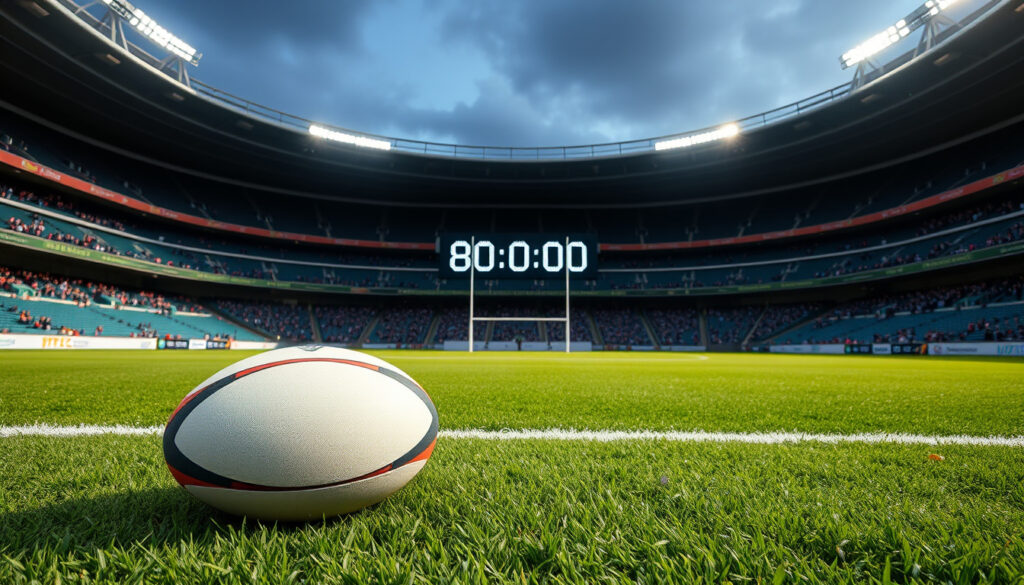
How Long Is a Rugby Match? 80-Minute Duration Explained
If you’ve ever settled in to watch a rugby match only to find yourself checking your watch after what feels like two hours, you’re not alone. The official playing time is exactly 80 minutes, split into two 40-minute halves, as defined by World Rugby Law 5.1 (World Rugby Passport – official law handbook).
Standard rugby match duration: 80 minutes (two 40-minute halves) ·
Half-time break: 10 minutes ·
Typical total elapsed time (including stoppages): 90–100 minutes ·
Youth match (u16) half duration: 30–35 minutes per half ·
Six Nations match total elapsed time: Approximately 100 minutes (80 + 10 half-time + stoppages) ·
World Cup match total elapsed time: Similar to standard; knockout matches may extend with extra time (20 minutes)
Quick snapshot
- 80 minutes total (two 40-minute halves) (World Rugby Passport)
- 10-minute half-time break (Rugby World – recognised rugby magazine)
- Clock stops for injuries, scrums, conversions (Northyard Blog)
- Typically 90–100 minutes including half-time and stoppages (Rugby World – recognised rugby magazine)
- Can exceed 100 minutes in high-stakes matches (Gametime Hero – sports scheduling platform)
- Varies by referee discretion (Northyard Blog)
- Six Nations: standard 80 min + half-time (Rugby World – recognised rugby magazine)
- World Cup: knockout matches have extra time (20 min) (World Rugby Passport)
- Rugby Sevens: 14 minutes total (two 7-min halves) (Northyard Blog)
- Under 16: 60–70 minutes (30–35 min halves) (Gametime Hero – sports scheduling platform)
- Under 14: 50–60 minutes (25–30 min halves) (Gametime Hero – sports scheduling platform)
- Under 12: 40 minutes (20 min halves) (Gametime Hero – sports scheduling platform)
The pattern: the standard is fixed but youth and tournament rules introduce the only real variability.
| Label | Value |
|---|---|
| Standard halves | 40 minutes each (World Rugby Passport) |
| Half-time length | 10 minutes (Rugby World – recognised rugby magazine) |
| Stoppage time | Not added; clock stops, total elapsed extends (Rugby World – recognised rugby magazine) |
| Youth half duration (u16) | 30–35 minutes (Gametime Hero – sports scheduling platform) |
| Youth half duration (u14) | 25–30 minutes (Gametime Hero – sports scheduling platform) |
| Extra time (World Cup knockout) | Two 10-minute halves (World Rugby Passport) |
Is rugby 80 or 90 minutes?
Why 80 minutes is the standard
- All senior rugby union matches last 80 minutes (two 40-minute halves) (World Rugby Passport – official law handbook).
- World Rugby Law 5.1 explicitly states the match “lasts no longer than 80 minutes” (World Rugby Passport).
- Rugby league matches also run 80 minutes, divided into two 40-minute halves (Northyard Blog).
What about 90-minute claims?
- 90 minutes is not standard for either code; confusion may arise from stoppages or other sports like football (Rugby World – recognised rugby magazine).
- Some broadcast schedules list the event slot as 2 hours, leading to mistaken 90-minute assumptions (Gametime Hero – sports scheduling platform).
The implication: 80 minutes is a firm rule, not a suggestion. Any claim of 90 minutes confuses broadcast window with playing time.
How long is a rugby match including half-time?
Half-time duration (10 minutes)
- The half-time interval “does not exceed 15 minutes” per World Rugby rules, but in practice it is 10 minutes (World Rugby Passport).
- Major tournaments like the Six Nations and World Cup use a 10-minute break (Rugby World – recognised rugby magazine).
Stoppage time and clock management
- The clock stops for injuries, TMO checks, substitutions, and scrums (Northyard Blog).
- There is no injury time added; lost time is made up by the stopped clock (Rugby World – recognised rugby magazine).
- Referees may also call a 2-minute water break in hot conditions (World Rugby Passport).
Total elapsed time from kick-off to final whistle
- A typical 80-minute match event lasts roughly two hours total from start to finish (Gametime Hero – sports scheduling platform).
- In high-stakes knockout matches, elapsed time can exceed 110 minutes (Rugby World – recognised rugby magazine).
What this means: if you’re planning to watch a full broadcast, block out at least 1 hour 45 minutes to be safe — the clock stops add up.
For fans attending live, the difference between 80 minutes of play and a 100-minute event means parking, train schedules, and post-match plans need a buffer. For broadcasters, that extra 20-40 minutes of dead air is part of the production budget.
How long is a Six Nations game?
Standard Six Nations match duration
- Every Six Nations match is the standard 80 minutes plus 10-minute half-time (Rugby World – recognised rugby magazine).
- No extra time in pool games; knockout matches may have extra time only in the final? Actually Six Nations has no knockout; it’s a round-robin. But the tournament has no extra time for pool matches (World Rugby Passport).
Any differences from regular matches?
- Six Nations matches follow the exact same World Rugby laws (World Rugby Passport).
- Total elapsed time typically around 100 minutes including stoppages (Rugby World – recognised rugby magazine).
How does half-time affect total time?
- The 10-minute interval is fixed; however, TV broadcasts often extend the break to 12-15 minutes for advertisements (Northyard Blog).
- Stoppages during play can add another 10-20 minutes (Gametime Hero – sports scheduling platform).
The trade-off: Six Nations delivers the same 80-minute core as any international, but the broadcast package — including analysis and ad breaks — can push the viewing experience past two hours.
How long is a rugby World Cup match?
Group stage vs knockout matches
- Group stage: 80 minutes + half-time, no extra time (World Rugby Passport).
- Knockout matches: may include 20 minutes extra time (two 10-minute halves) and a sudden-death period if tied (World Rugby Passport).
Extra time and golden point rule
- If scores are level after extra time, the match goes to sudden death (next score wins) (Rugby World – recognised rugby magazine).
- World Cup matches can run 110–120 minutes total including half-time and stoppages (Northyard Blog).
Total duration including breaks
- The standard 10-minute half-time applies; in extra time there is a 5-minute break between full-time and extra time (World Rugby Passport).
- Stoppages for TMO and injury are common in high-stakes matches, further extending elapsed time (Rugby World – recognised rugby magazine).
The pattern: World Cup knockout matches are the only scenario where the total event can reliably exceed two hours. Fans booking tickets should plan for a 2.5-hour window.
Sudden death has no time limit — a World Cup final could theoretically stretch indefinitely. That makes it the most unpredictable match type for schedulers and broadcasters alike.
How long is a rugby match for under 16?
Youth rugby match durations by age group
- Under 16 matches typically have 30–35 minute halves (total 60–70 minutes) (Gametime Hero – sports scheduling platform).
- Under 14 matches often have 25–30 minute halves (total 50–60 minutes) (Gametime Hero – sports scheduling platform).
- Under 12 matches are 20 minutes per half (total 40 minutes) (Gametime Hero – sports scheduling platform).
Why shorter halves are used
- Shorter match durations reduce physical strain and injury risk for developing players (Gametime Hero – sports scheduling platform).
- World Rugby’s age-grade regulations recommend graduated playing times to match players’ physiological readiness (World Rugby Passport).
The implication: parents and coaches need to know that a youth game may only last an hour — quite different from the 100-minute senior experience. Plan accordingly for travel and multiple fixtures.
How rugby match durations compare across codes
Four match types, one pattern: the 80-minute senior standard is the norm, but sevens and age-grade competitions compress the action significantly.
| Match Type | Total Playing Time | Half Duration |
|---|---|---|
| Rugby Union (Senior) | 80 min | 40 min (World Rugby Passport) |
| Rugby League (Senior) | 80 min | 40 min (Northyard Blog) |
| Rugby Sevens | 14 min | 7 min (Northyard Blog) |
| Under 16 (Union) | 60–70 min | 30–35 min (Gametime Hero – sports scheduling platform) |
| Under 14 (Union) | 50–60 min | 25–30 min (Gametime Hero – sports scheduling platform) |
| Under 12 (Union) | 40 min | 20 min (Gametime Hero – sports scheduling platform) |
The trade-off: the more compressed the format, the higher the intensity per minute. Sevens players cover more ground at speed than union forwards in the same 7 minutes.
What we know and what remains unclear
Confirmed facts
- Senior rugby union matches are 80 minutes (two 40-minute halves) (World Rugby Passport).
- Half-time break is 10 minutes (Rugby World – recognised rugby magazine).
- World Rugby law 5.1 specifies 40-minute halves (World Rugby Passport).
- Six Nations matches follow the same standard (Rugby World – recognised rugby magazine).
- Youth matches have shorter halves (30–35 min for u16) (Gametime Hero – sports scheduling platform).
What’s unclear
- Exact total elapsed time varies due to stoppages; no fixed figure (Rugby World – recognised rugby magazine).
- Youth match durations can differ by national union (Gametime Hero – sports scheduling platform).
- Extra time rules in domestic cup competitions may vary (World Rugby Passport).
- Referees add stoppage time at their discretion — exact time not publicly tracked (Northyard Blog).
- A typical 80-minute match event lasts roughly two hours total, but this is an estimate, not a rule (Gametime Hero – sports scheduling platform).
Expert perspectives on match duration
“A rugby match is played in two 40-minute halves, and while the clock is stopped for injuries and TMO checks, there is no injury time added because the clock simply stops.”
Rugby World – leading rugby magazine
“The duration of a match is no longer than 80 minutes, split into two halves of not more than 40 minutes, plus time lost.”
World Rugby Passport – official law handbook
“The total elapsed time from kick-off to final whistle, including half-time and stoppages, typically runs between 90 and 100 minutes.”
Gametime Hero – sports scheduling platform
For the average fan planning a Saturday outing, the data is clear: budget at least 90 minutes for a standard match, 100 minutes for a tournament game, and up to 2.5 hours for a World Cup knockout. For coaches and parents of youth players, the 40–70 minute window means you can fit multiple fixtures into a morning without exhausting young athletes. The single most practical takeaway: the 80-minute playing time is the only constant — everything else is variable, and knowing the rules of that variability separates an informed spectator from someone checking their watch.
Frequently asked questions
What is the half-time duration in rugby?
The half-time interval is typically 10 minutes, but World Rugby allows up to 15 minutes at the organiser’s discretion (World Rugby Passport).
Do rugby matches ever go over 80 minutes?
No — the playing time is strictly 80 minutes. However, the clock stops for stoppages, and the official match may extend beyond 80 minutes of elapsed time until the ball goes out of play (Rugby World – recognised rugby magazine).
How long is a rugby sevens match?
A standard sevens match lasts 14 minutes, played in two 7-minute halves (Northyard Blog).
How long is a rugby match for 12 year olds?
Under 12 matches are typically 40 minutes total, with two 20-minute halves (Gametime Hero – sports scheduling platform).
Why is rugby 80 minutes long?
The 80-minute duration was historically chosen to balance stamina, strategy, and spectator entertainment — World Rugby codified it as Law 5.1 (World Rugby Passport).
How long does a rugby match last on TV?
Broadcast slots typically run 2 hours to cover pre-match analysis, half-time coverage, and post-match chat (Northyard Blog).
Is there extra time in rugby union?
Extra time (two 10-minute halves) is used only in knockout matches where a winner must be determined, such as World Cup finals (World Rugby Passport).
More related posts
 Steve McQueen: Cause of Death, Smoking & True Love
 The Crown Season 4 Cast: Full List, Characters, and Behind the Scenes
 800 Euros in Pounds – Current Rate and Conversion Guide
 D Wave Share Price: QBTS Live Quote, Forecast & Analysis
 Karen Henthorn: Coronation Street & EastEnders Actress
 Laurence Llewelyn-Bowen: Biography, Net Worth & News
 James Bourne: Surgery, Split, and Songwriting Career
 Head Shower: Types, Lifespan, and Health Connection