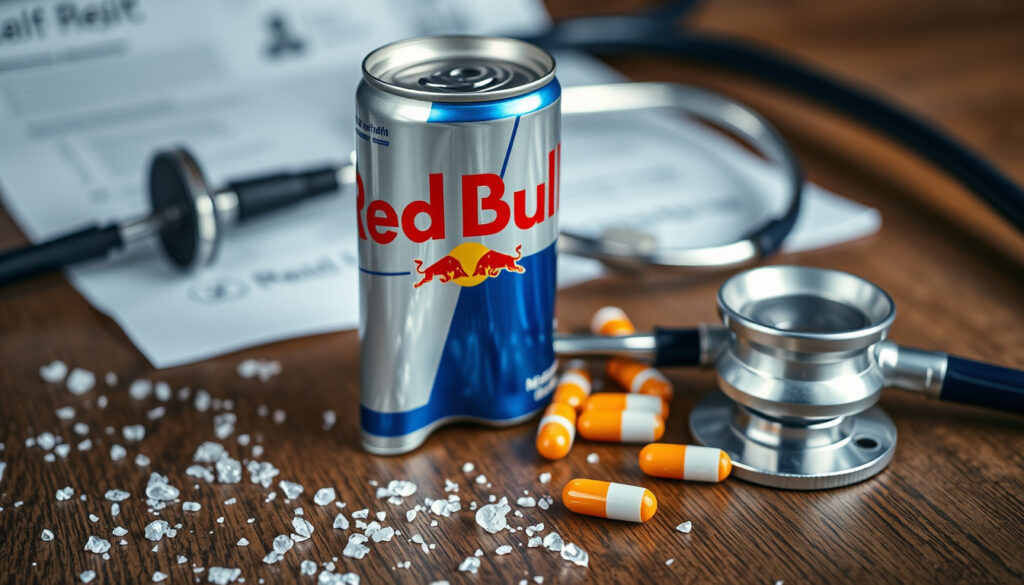
Red Bull: Ingredients, Health Effects, and Myths vs. Facts
Anyone who has cracked open a can of Red Bull after a long afternoon knows the jolt it promises, but behind the silver-and-blue can lies a swirl of questions — does it actually contain bull sperm, is taurine harvested from bull testicles, and just how much sugar are you really drinking? This article separates the verified science from the persistent myths, with hard numbers on caffeine, sugar, and what each ingredient actually does in your body.
Global market share: 13% (2024) ·
Caffeine per 8.4 oz can: 80 mg ·
Sugar per 8.4 oz can: 27 g ·
Founded: 1987 (Austria) ·
Alcohol content: 0% (non-alcoholic)
Quick snapshot
- 80 mg caffeine per 8.4 oz can (Red Bull official ingredients)
- 27 g sugar per 8.4 oz can (One Stop product PDF)
- Zero alcohol content (Wikipedia – Red Bull)
- Taurine is synthetic, not from bulls (EFSA safety opinion)
- Long-term health effects of moderate energy drink consumption are not fully established (PubMed Central systematic review)
- Individual caffeine sensitivity varies widely (PubMed Central systematic review)
- Whether taurine at energy-drink levels meaningfully improves performance remains debated (PubMed Central systematic review)
- 1987: Red Bull launched in Austria (Wikipedia – Red Bull)
- 2009: EFSA concluded taurine is safe at energy-drink levels (EFSA 2009 opinion)
- 2024: Red Bull holds 13% of global energy drink market (Wikipedia – Red Bull)
- Growing scrutiny of high-sugar beverages and caffeine limits for minors
- Emerging low-sugar and no-caffeine energy drink alternatives
- Further research into long-term metabolic effects of routine energy drink use
The table below provides a concise overview of Red Bull’s nutritional profile.
| Attribute | Value |
|---|---|
| Caffeine per can (8.4 oz) | 80 mg |
| Sugar per can (8.4 oz) | 27 g |
| Calories per can | 110 |
| Taurine per can | 1000 mg |
| Alcohol content | 0% |
| Global market share (2024) | 13% |
Is Red Bull a healthy energy drink?
Nutritional profile of Red Bull
- 110 calories per 8.4 oz can, with nearly all energy coming from sugar.
- 27 g of sugar — roughly 6.5 teaspoons — per serving (myboone.app nutrition listing).
- Contains 80 mg caffeine, comparable to one small cup of coffee (Foods Co. product listing).
- Includes B vitamins: niacin (B3), pantothenic acid (B5), vitamin B6, and vitamin B12 (One Stop product PDF).
- Taurine content in energy drinks ranges widely — from 250 mg/L to 4000 mg/L, according to the Finnish Food Authority.
Red Bull’s sugar content alone puts it in the same category as many sodas. The American Heart Association recommends no more than 36 g of added sugar per day for men and 25 g for women — one can uses up most of that allowance.
For anyone watching sugar intake, a single Red Bull wipes out nearly the entire daily recommended limit. The caffeine gives alertness, but the sugar load carries metabolic consequences that regular consumers need to weigh.
Comparison with other energy drinks
Three major brands, one clear pattern in sugar and caffeine density.
| Drink (8.4–8.5 oz) | Caffeine | Sugar | Calories |
|---|---|---|---|
| Red Bull Original | 80 mg | 27 g | 110 |
| Monster Original (8.4 oz equivalent) | 86 mg | 27 g | 110 |
| Rockstar Original (8.4 oz equivalent) | 80 mg | 26 g | 105 |
The implication: Among mainstream energy drinks, the nutritional profiles are nearly identical. The meaningful difference is not in the numbers but in the brand-specific additives and marketing claims.
What exactly does Red Bull do?
Caffeine mechanism of action
- Caffeine blocks adenosine receptors in the brain, reducing the sensation of fatigue (Wikipedia – Caffeine).
- The 80 mg dose in a standard can is enough to produce measurable improvements in alertness and reaction time for most adults.
- Caffeine effects peak around 30–60 minutes after consumption and can last 4–6 hours.
Taurine and B-vitamins role
- Taurine is a naturally occurring amino acid found in the human body, not extracted from bull testicles — a persistent myth with no factual basis. The taurine in Red Bull is synthetically produced (EFSA safety assessment).
- The Finnish Food Authority notes that average dietary taurine intake from food is about 100 mg per day — a can of Red Bull adds 1000 mg, far exceeding that baseline (One Stop product PDF).
- B vitamins play a role in energy metabolism, but they are not stimulants — they help convert food into energy at the cellular level.
- One systematic review found that common energy-drink doses (80 mg caffeine + 1 g taurine) were ineffective at improving motor or cognitive performance in the studies examined (EC Scientific Committee opinion).
What this means: The primary active ingredient is caffeine. Taurine and B vitamins play supporting roles that are far less dramatic than marketing suggests.
What are the benefits of Red Bull?
Short-term mental alertness
- Improves reaction time and concentration for 1–2 hours after consumption, driven almost entirely by caffeine.
- Convenient caffeine delivery — no brewing, no waiting, a portable can.
- Useful for shift workers or drivers needing a short-duration alertness boost.
Physical performance during fatigue
- May enhance endurance in short-duration, high-intensity bursts when consumed before activity.
- Carbohydrates (sugar) provide quick energy for glycogen-depleted muscles during exercise lasting under 60 minutes.
- About the same caffeine as one espresso, making it a viable pre-workout option for those who tolerate caffeine well.
The catch: These benefits are caffeine-dependent, not unique to Red Bull. A cup of black coffee delivers the same alertness with zero sugar.
Is Red Bull alcohol or not?
Legal classification of Red Bull
- Red Bull contains 0% alcohol by volume and is legally classified as a non-alcoholic beverage.
- The myth that Red Bull contains alcohol likely arises from its common use as a mixer with spirits (e.g., Vodka Red Bull).
- Some countries have debated restricting energy drink sales to minors due to caffeine and sugar content, not alcohol.
Red Bull alcohol percentage
- Labelled as 0.0% ABV on products in regulated markets.
- The European Food Safety Authority and other regulatory bodies treat Red Bull as a non-alcoholic food product.
- Mixing Red Bull with alcohol is a separate consumer choice — the energy drink itself contains no ethanol.
Why this matters: The alcohol myth persists on social media, but regulatory labels across the US and EU consistently confirm zero alcohol content.
Red Bull is non-alcoholic. Mixing it with spirits changes the equation, but the can in your hand is as alcohol-free as a soda.
What are the downsides of Red Bull?
High sugar content risks
- 27 g of sugar per 8.4 oz can — regular consumption is linked to weight gain, insulin resistance, and type 2 diabetes.
- A 20 fl oz can contains 63 g of sugar — more than two days’ recommended intake for women (Foods Co. large can data).
- Dental health: sugar and acidity combine to erode enamel over time.
Caffeine overconsumption side effects
- 80 mg per standard can is moderate, but multiple cans can cause anxiety, insomnia, heart palpitations, and digestive issues.
- Individual sensitivity varies — some people experience jitters after a single can.
- Not recommended for children, pregnant women, or individuals with heart conditions.
Potential impact on sperm quality
- The myth that Red Bull contains bull sperm is entirely false — no animal reproductive material is used in production.
- Moderate caffeine consumption (up to 300 mg per day) has not been shown to harm sperm quality in men.
- High-dose caffeine (above 500 mg daily) has been associated with sperm motility changes in some studies, but evidence is not conclusive.
The pattern: The real downsides are sugar and caffeine volume, not the bizarre myths circulating online. Moderation is the dividing line between reasonable use and risk.
The sugar content alone — 27 g in one small can — makes it a beverage to limit, not to reach for daily. For people with caffeine sensitivity, even the moderate 80 mg dose can trigger noticeable side effects.
Upsides
- Quick caffeine boost for alertness
- Portable and convenient
- Contains B vitamins
- Non-alcoholic
- Comparable caffeine to coffee
Downsides
- High sugar content (27 g per 8.4 oz)
- Can cause caffeine jitters
- No unique performance advantage over coffee
- Regular consumption linked to metabolic risks
- Large sizes pack 63 g sugar
What is confirmed and what remains unclear
Confirmed facts
- Red Bull contains 80 mg caffeine per 8.4 oz can (Red Bull)
- Red Bull is non-alcoholic
- Taurine in Red Bull is synthetic, not from bulls’ testicles (EFSA)
- Red Bull does not contain bull sperm
- 110 calories and 27 g sugar per 8.4 oz can (myboone.app nutrition)
- EFSA (2009) found taurine safe at energy-drink levels (EFSA opinion)
What’s unclear
- Long-term health effects of moderate energy drink consumption are not fully established
- Individual sensitivity to caffeine varies widely
- Whether taurine at 1000 mg per can meaningfully improves performance beyond caffeine alone (PubMed Central review)
- Earlier European Commission scientific committee said taurine safety in energy drinks had not been adequately established (EC Scientific Committee opinion)
The evidence shows that many common beliefs about Red Bull are myths, while the real concerns center on sugar and caffeine.
Expert perspectives on Red Bull
The 80 mg of caffeine in one 8.4 fl oz can of Red Bull is comparable to one small cup of coffee or one espresso, depending on brew size.
— Foods Co., product listing comparison (Foods Co. product page)
Exposure to taurine and D-glucurono-gamma-lactone at the concentrations commonly used in energy drinks was not a safety concern even for high consumers.
— European Food Safety Authority, 2009 scientific opinion (EFSA 2009 opinion)
Common energy-drink doses such as Red Bull’s 80 mg caffeine and 1 g taurine were ineffective in improving motor or cognitive performance in the reviewed studies.
— Systematic review, PubMed Central (PMC systematic review)
These three perspectives frame the debate: Red Bull delivers caffeine reliably, taurine is safe at the doses used, but the supposed synergy of caffeine plus taurine is not backed by strong performance data.
Related reading: Paul Simon: Health, Career, and Biography – Key Facts and Updates · Meghan Trainor: Health, Family, and Cosmetic Changes
Frequently asked questions
Does Red Bull help you stay awake?
Yes, the 80 mg of caffeine per 8.4 oz can blocks adenosine receptors in the brain, temporarily reducing the sensation of fatigue. Effects last about 4–6 hours for most people.
Can Red Bull cause dehydration?
Caffeine has a mild diuretic effect, but at 80 mg per can, the fluid volume offsets water loss. Moderate consumption is not dehydrating, though it should not replace plain water.
How much Red Bull is safe per day?
Health authorities generally recommend limiting caffeine to 400 mg per day for adults — equivalent to about 5 standard 8.4 oz cans. However, the sugar content (27 g per can) suggests limiting to one can or choosing a sugar-free version.
Is Red Bull worse than coffee?
For caffeine delivery, a standard 8 oz coffee has about 95 mg caffeine versus Red Bull’s 80 mg — similar. The difference is sugar: black coffee has zero, while Red Bull has 27 g per can. Coffee also provides antioxidants that Red Bull lacks.
Can Red Bull affect heart health?
In sensitive individuals, caffeine can raise heart rate and blood pressure temporarily. For those with pre-existing heart conditions, excessive consumption may trigger palpitations. Moderate intake (1–2 cans) is generally safe for healthy adults.
Does Red Bull have any vitamins?
Yes, Red Bull contains niacin (B3), pantothenic acid (B5), vitamin B6, and vitamin B12, which support energy metabolism. However, these are added in small amounts and are not a primary reason to consume the drink (One Stop product PDF).
Is Red Bull suitable for athletes?
For short-duration, high-intensity activity, the caffeine and sugar can provide a quick energy boost. For endurance or hydration-dependent sports, it is less suitable than water or electrolyte drinks. The sugar content may cause digestive discomfort during exercise.
For the average adult who drinks one can occasionally, Red Bull is not a health hazard — but it is not a health food either. The decision comes down to what you want from it: a caffeine boost with a sugar cost, or a cleaner alternative like black coffee or tea.
More related posts
 Dorian Yates: What Ended His Career, Diet, and Life Now
 Mark Rutte: Biography, Personal Life, and NATO Role
 Paul Simon: Health, Career, and Biography – Key Facts and Updates
 Peter Sarsgaard: Career, Family, and Biography
 King Charles III: Diagnosis, Succession, and Future
 Laurence Llewelyn-Bowen: Biography, Net Worth & News
 Larry Ellison Net Worth, Oracle Founder, Politics & Wives
 Portugal vs Spain National Team Stats: Head-to-Head & History