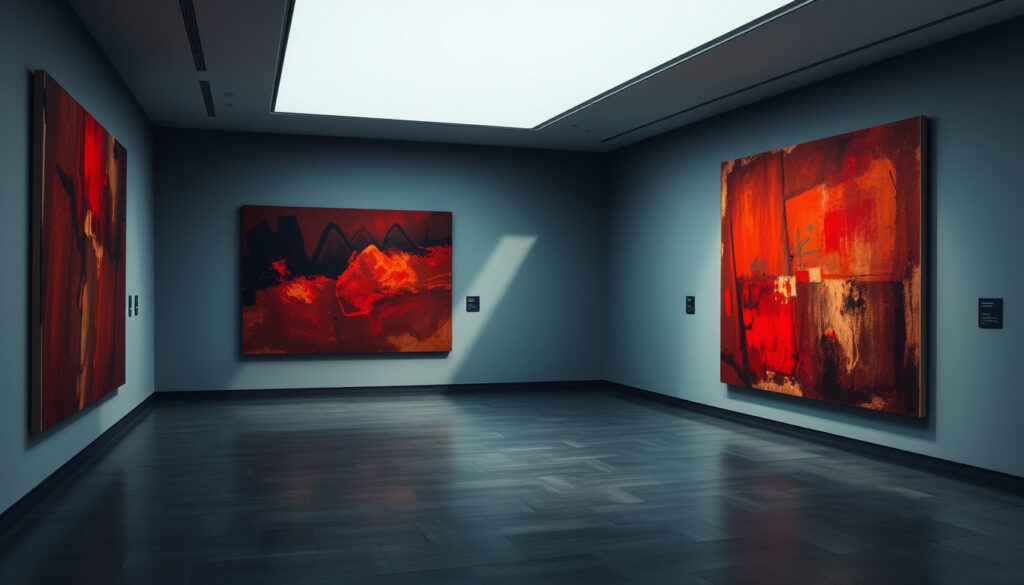
Mark Rothko: Color Field Paintings and Legacy
Few artists demand stillness the way Mark Rothko does. Step in front of one of his luminous color fields, and something shifts — the painting seems to breathe, pulling you into a space where color becomes feeling.
Born: 1903 ·
Died: 1970 ·
Years active (color field): 1949–1970 ·
Number of children: 2 ·
Art movement: Color Field, Abstract Expressionism
Quick snapshot
- Born Marcus Rothkowitz on September 25, 1903 in Dvinsk, Russia (Portland Art Museum)
- Immigrated to the United States in 1913 (Portland Art Museum) (Portland Art Museum)
- Died by suicide on February 25, 1970 (The Art Story)
- Exact intended meaning of his abstract works
- Whether Rothko deliberately aimed to create the “Rothko effect”
- Full extent of his depression diagnosis (known only through secondary sources)
- Whether Rothko’s late dark palette was directly caused by depression (debated)
- The exact number of fully realized color field paintings (varying estimates)
- 1949: Developed signature color field style (The Art Story)
- 1964: Commissioned for Rothko Chapel murals (The Art Story)
- Ongoing scholarly debate about the relationship between his late dark palette and his mental state
- Continued museum exhibitions (e.g., Portland Art Museum)
Here are the essential biographical facts about Rothko.
| Attribute | Detail |
|---|---|
| Full Name | Marcus Rothkowitz |
| Born | September 25, 1903 |
| Died | February 25, 1970 |
| Nationality | American (born in Russia) |
| Art Movement | Abstract Expressionism, Color Field |
| Known For | Color field paintings |
Who Is Mark Rothko?
When was Mark Rothko born?
- Born Marcus Rothkowitz on September 25, 1903 in Dvinsk, Russia (now Latvia) (Portland Art Museum)
- Immigrated with his family to the United States in 1913 (Portland Art Museum)
What was his early life like?
Rothko entered Yale University in 1921 but left in 1923 to pursue art full time in New York City (The Art Story). His early 1930s work was figurative, often depicting claustrophobic urban scenes in acidic colors (The Art Story).
Who was his wife?
- Rothko married Mary Alice Beistle; later he married Ann Swet (The Art Story)
- He had two children: Kate and Christopher (The Art Story)
How did Mark Rothko die?
Rothko died by suicide on February 25, 1970 in his New York studio. One account reports he overdosed on barbiturates and cut an artery in his arm (Wikiwand summary of Rothko biography). He had struggled with depression in the period before his death (Wikiwand).
Rothko’s final paintings are commonly described as darker in palette — blacks, maroons, deep reds — yet art historian David Anfam has rejected the idea that these works are simply symptoms of depression, arguing they continue lifelong artistic themes (Wikiwand summary of Rothko biography). The trade-off: we risk flattening a deliberate artistic choice into a biographical footnote.
The implication is that Rothko’s work cannot be reduced to a simple narrative of despair; it carries its own formal logic.
What is so special about Mark Rothko?
Why are Rothko’s paintings so powerful?
Rothko’s mature style uses soft rectangular forms floating on fields of color, but the emotional impact comes from his technique. He applied thin layers of pigment and binder on bare canvas, then multiple thinned oil coatings, creating a luminous glow (Humanities LibreTexts). The fuzzy boundaries between color zones make the paintings seem to breathe (Teravarna).
What emotions do they evoke?
Rothko famously stated: I am not an abstractionist. I am interested only in expressing basic human emotions: tragedy, ecstasy, doom.
He intended his paintings to be experienced as emotionally immersive and sometimes spiritual (The Art Story).
How did he use color and scale?
His large-scale canvases envelop the viewer’s field of vision. The Portland Art Museum frames his work as central to the evolution of abstract art in the mid‑twentieth century (Portland Art Museum). The effect is not decorative but meditative.
For anyone visiting a museum today, understanding Rothko’s technique — the layering, the soft edges — is the difference between seeing a “red rectangle” and experiencing a field of emotion. The physical craft is what separates his best works from mere color blocks.
The pattern shows that Rothko’s craft is inseparable from the emotional effect, making his paintings both technical achievements and emotional triggers.
What is the Rothko effect?
Where does the term come from?
Art critics coined the “Rothko effect” to describe the visceral, almost physical response viewers have to his paintings — a sense of floating or being enveloped by color. The effect is often linked to the Rothko Chapel in Houston, where his dark, meditative panels surround the viewer in silence (The Art Story).
What does the Rothko effect describe?
It’s not a formal academic term but a shorthand for the way Rothko’s work bypasses intellectual analysis and hits the nervous system directly. Critics have described it as a “spiritual” or “transcendent” encounter, achieved through scale, color temperature, and the soft bleeding of edges.
What is Mark Rothko’s art style?
Color field painting explained
Rothko is considered a pioneer of Color Field painting, though he rejected labels like “abstractionist” (The Art Story). His mature style features irregular, stacked rectangles of color with softly blended boundaries (Teravarna).
Influence of Abstract Expressionism
As a member of the New York School, Rothko helped define Abstract Expressionism (The Art Story). But he differed from action painters like Pollock; his process was slow, layered, and meditative.
Evolution of his style
Rothko began with figurative, urban scenes in the 1930s. By the late 1940s, he had shifted entirely to large-scale color fields intended to evoke emotion rather than represent the world (Portland Art Museum).
How much is Rothko painting worth?
Rothko’s works are among the most expensive at auction. While his paintings regularly sell for tens of millions, the market reflects his status as a pillar of 20th-century art. The rarity of his major color fields — he produced only a limited number before his death — and the high demand from institutional collectors drive prices.
What this means is that Rothko’s market value is a reflection of his cultural weight, not just aesthetic appeal.
Timeline: Key moments in Mark Rothko’s life
The following timeline traces Rothko’s life from birth to death.
| Date | Event |
|---|---|
| 1903 | Born Marcus Rothkowitz in Dvinsk, Russia (Portland Art Museum) |
| 1913 | Immigrated to the United States (Portland Art Museum) |
| 1923–1929 | Studied at Art Students League, began painting (Portland Art Museum) |
| 1949 | Developed signature color field style (The Art Story) |
| 1964 | Commissioned to create paintings for the Rothko Chapel |
| 1970 | Died by suicide in his New York studio (The Art Story) |
What we know — and what remains unclear
Confirmed facts
- Birth and death dates (1903–1970)
- Marriage to Mary Alice Beistle and later Ann Swet (The Art Story)
- Two children: Kate and Christopher (The Art Story)
- Artistic phases: figurative early works, then color fields after 1949 (The Art Story)
- Suicide by overdose and exsanguination (Wikiwand summary of Rothko biography)
What’s unclear
- Exact intended meaning of his abstract works (Rothko himself refused to decode them)
- Whether Rothko specifically aimed to create the “Rothko effect” — critics coined the term posthumously
- Full extent of depression diagnosis (only known from secondary sources)
- Whether Rothko’s late dark palette was directly caused by depression (debated)
- The exact number of fully realized color field paintings (varying estimates)
Voices on Rothko
I am not an abstractionist. I am not interested in the relationship of color or form or anything else. I am interested only in expressing basic human emotions: tragedy, ecstasy, doom.
— Mark Rothko, as quoted in The Art Story
Rothko’s late works have often been interpreted as linked to depression or suicide, but that interpretation has been criticized. David Anfam rejected the idea that they are simply symptoms of depression, arguing they continue lifelong artistic themes.
— Summary from Wikiwand summary of Rothko biography
facebook.com, teravarna.com, carredartistes.com, repository.lsu.edu, artalistic.com, reddit.com, en.wikipedia.org, ideelart.com, phillips.com, parisactu.fr
The value of Rothko’s work is so immense that even minor damage can be catastrophic, as seen in Rotterdam where a child accidentally damaged a Rothko painting.
Frequently asked questions
Where can I see Rothko’s paintings?
Major collections are held at the Museum of Modern Art (MoMA) in New York, the Tate Modern in London, the National Gallery of Art in Washington, D.C., and the Rothko Chapel in Houston.
What is the Rothko Chapel?
A non-denominational chapel in Houston, Texas, featuring fourteen of Rothko’s large, dark paintings. It was commissioned in 1964 and is considered the culmination of his vision.
How many paintings did Rothko create?
He produced hundreds of works, but the number of fully realized color field paintings from his mature period (1949–1970) is limited, contributing to their market value.
What techniques did Rothko use to get his luminous effect?
He applied thin layers of pigment and binder on bare canvas, followed by multiple thinned oil coatings. The fuzzy boundaries between color blocks were achieved by softening edges while the paint was still wet (Humanities LibreTexts).
Was Mark Rothko successful during his lifetime?
Yes. He achieved critical recognition and financial success by the 1950s, with major museum acquisitions and gallery representation, though he remained anxious about his legacy.
Did Mark Rothko have any children?
Yes, two: Kate and Christopher, from his marriage to Ann Swet.
What other artists influenced Mark Rothko?
He was inspired by the European modernists Matisse, Miró, and Kandinsky, as well as by myth and philosophy. His early figurative work shows the influence of Milton Avery. For more on artists who transformed personal struggles into iconic art, see our profiles on Cindy Sherman and Sylvia Plath.
Rothko’s story is not just a biography of paint and depression — it’s a case study in how an artist’s inner life becomes impossible to separate from the work itself. For anyone standing in front of a Rothko today, the implication is clear: you are not just seeing color; you are encountering a man who spent his final years pushing darkness into something that could be faced, shared, and ultimately sold. For museum curators and collectors, the choice is whether to present that darkness as a biographical key or as a deliberate artistic language. The most honest reading may be both, held in tension.
More related posts
 Kim Seon-Ho: Biography, Scandal, Comeback, and Full Filmography
 Signs of Mouth Cancer: Early Symptoms, Warning Signs & Self-Test
 White Jeans for Women in Ireland: Buy, Style & Care
 What Are the 34 Symptoms of Perimenopause – Stages, Timeline and Relief
 New Zealand vs India Cricket Timeline 2025/26: Schedule & Results
 Declan Donnelly: Biography, Health, Family, and Recent News
 Bob Dylan: Biography, Famous Songs, Wives, Health, Net Worth
 Pierson Fode: Disney Star Turned Netflix Actor and Farmer