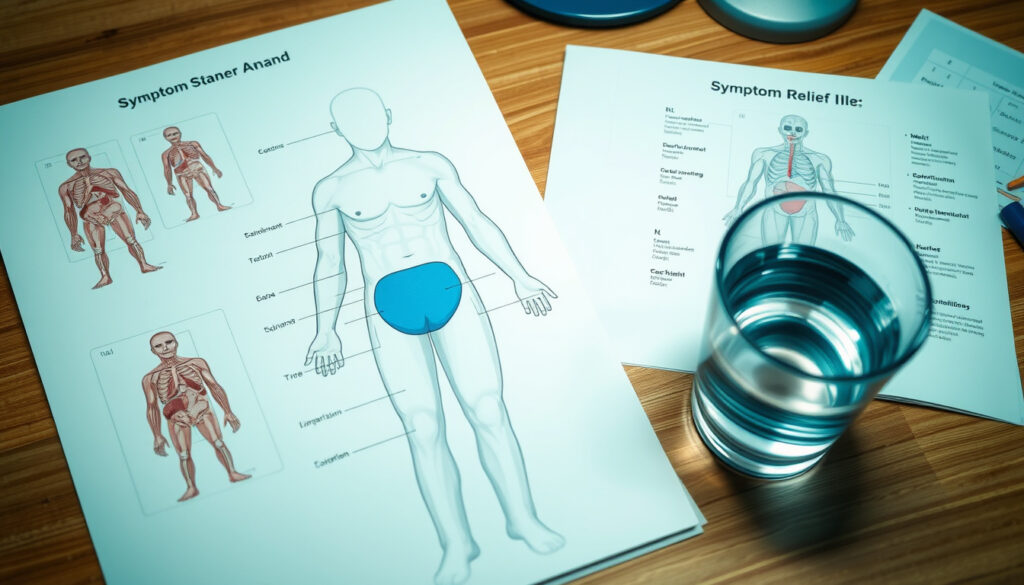
Blue Balls: What It Is, Causes, and How to Get Relief
The term “blue balls” describes a temporary ache in the testicles after arousal without orgasm, yet it is often misunderstood and misused. Medically known as epididymal hypertension, it is harmless and resolves with simple self-care.
Medical term: Epididymal hypertension ·
Colloquial name: Blue balls ·
Occurrence: After arousal without orgasm ·
Treatment: Ejaculation or cold compress
Quick snapshot
- Temporary scrotal pain (Cleveland Clinic)
- Medically called epididymal hypertension (Cleveland Clinic)
- Occurs after arousal without orgasm (Sexual Medicine Society of North America)
- Not dangerous (Cleveland Clinic)
- Sustained sexual arousal (Cleveland Clinic)
- Blood pooling in testicles (Healthy Male (Australia))
- Venous outflow restricted during erection (Healthy Male)
- Ejaculation (masturbation or intercourse) (SMSNA)
- Cold compress or cold shower (Cleveland Clinic)
- Light exercise (Cleveland Clinic)
- Distraction and relaxation (Cleveland Clinic)
- Pain lasting more than a few hours (Cleveland Clinic)
- Swelling or lumps (SMSNA)
- Blood in urine or semen (Healthy Male)
- Fever or nausea (Healthy Male)
Five key facts, one takeaway: the condition is harmless, treatable, and often misunderstood.
| Label | Value |
|---|---|
| Medical term | Epididymal hypertension |
| Affected group | Primarily males |
| Prevalence | Common, exact rates unknown |
| Treatment effectiveness of ejaculation | High |
| Risk of complications | Very low |
What exactly does being blueballed mean?
Medical term: epididymal hypertension
- The phrase “blue balls” describes a feeling of pressure or discomfort in the testicles after sexual arousal that doesn’t end in orgasm (Cleveland Clinic).
- Clinicians commonly refer to it as epididymal hypertension (Cleveland Clinic).
Difference between myth and fact
- Myth: Blue balls is a serious medical condition. Fact: It is not considered a medical condition and is not dangerous (Cleveland Clinic).
- Myth: You need a partner to relieve it. Fact: Masturbation or self-care methods work fine (Sexual Medicine Society of North America).
Blue balls is real but benign — calling it “hypertension” makes it sound scarier than it is. The discomfort is short-lived and resolves on its own.
The implication: much of the confusion around this condition comes from its sensational name, not its medical reality.
What causes a blue testicle?
Physiological mechanism of blood pooling
- During sexual arousal, blood flow increases to the penis and testicles. The epididymis fills with blood, creating pressure (Cleveland Clinic).
- If orgasm occurs, the blood drains and pressure drops. Without orgasm, the blood stays longer, causing a feeling of heaviness (Cleveland Clinic).
- Healthy Male (Australia) describes how venous outflow is restricted to maintain an erection, trapping blood in the testicles (Healthy Male (Australia)).
Role of sexual arousal
- Sustained arousal without release is the primary trigger. The longer the arousal, the more blood accumulates (SMSNA).
Some people use the term to pressure partners into sex. Healthy Male (Australia) explicitly states: “Blue balls is not a reason to pressure a partner into sexual activity.” (Healthy Male (Australia))
What this means: the physiological cause is straightforward, but the weaponization of the term creates unnecessary social harm.
Does ejaculating give relief for testicle pain?
Ejaculation as primary relief
- Ejaculation (through masturbation or with a consenting partner) is the most effective way to relieve epididymal hypertension (SMSNA).
- Orgasms allow the blood to drain from the epididymis and testicles, returning them to normal (Cleveland Clinic).
Other methods: cold compress, exercise
- A cold compress or cold shower constricts blood vessels, reducing swelling (Cleveland Clinic).
- Light exercise diverts blood flow away from the genitals (Cleveland Clinic).
- Distraction and relaxation techniques also help (Cleveland Clinic).
Relief is usually within reach — no partner required. The myth that you “need” someone else to fix it is false and can be coercive.
The pattern: ejaculation is the fastest route, but other methods work when desired or needed.
How to get rid of blue balls?
Steps for immediate relief
- Ejaculate – Masturbate or engage in consensual sexual activity. Orgasms release the trapped blood (SMSNA).
- Apply cold – Use a cold pack or take a cold shower to constrict vessels (Cleveland Clinic).
- Move your body – Light exercise like walking or stretching shifts blood flow away from the groin (Cleveland Clinic).
- Distract yourself – Do something non-arousing: watch a movie, read, play a game (Cleveland Clinic).
- Take a warm shower – Warmth relaxes pelvic muscles, helping blood circulate away (Cleveland Clinic).
When to see a doctor
- If pain lasts more than a few hours despite relief attempts, consult a doctor (Cleveland Clinic).
- See a doctor if you notice swelling, lumps, blood in urine or semen, fever, or nausea (SMSNA).
The catch: while self-care works for most, persistent or severe symptoms warrant medical attention.
Why are my boyfriend’s balls always tight?
Common causes: arousal, temperature, anxiety
- The cremaster muscle pulls the testicles closer to the body when cold, anxious, or sexually aroused – all normal (Cleveland Clinic).
- Persistent tightness without a clear trigger may indicate a condition like varicocele or testicular torsion (Healthy Male (Australia)).
When tightness signals a problem
- See a doctor if tightness is constant, painful, or accompanied by nausea or vomiting (SMSNA).
The implication: occasional tightness is normal physiology, but persistent symptoms require evaluation.
Are saggy testicles normal?
Age-related changes
- Scrotal skin loosens naturally with age and temperature regulation (Healthy Male (Australia)).
- Some droop is normal – testicles hang lower when warm to cool off.
When sagging is a concern
- Sudden or painful sagging could indicate a hernia or fluid buildup – worth a check-up (Cleveland Clinic).
What this means: changes in scrotal appearance are often benign, but sudden shifts should not be ignored.
Is it bad for a man to release sperm every day?
Health effects of frequent ejaculation
- Daily ejaculation is safe for most men and does not cause blue balls or any harm (SMSNA).
- Regular ejaculation may even reduce the risk of prostate issues (Cleveland Clinic).
Relation to blue balls
- Blue balls is caused by arousal without release, not by frequency of release. Releasing daily does not cause it (Cleveland Clinic).
The pattern: frequent ejaculation is safe and may offer health benefits, separate from the arousal-without-release phenomenon.
Clarity: What we know and what’s still unclear
Confirmed facts
- Blue balls is a real but harmless condition (Cleveland Clinic).
- Relief through ejaculation is the most effective method (SMSNA).
- Other methods (cold, exercise, distraction) also help (Cleveland Clinic).
What’s unclear
- Exact prevalence rates are not established (Healthy Male).
- Long-term effects, if any, are not documented (Healthy Male).
The catch: our knowledge is solid on safety and relief, but population-level data remain sparse.
Voices from the experts
“Blue balls is a feeling of pressure or discomfort in the testicles after sexual arousal does not end in orgasm.”
Cleveland Clinic Health Essentials
“Blue balls is not a reason to pressure a partner into sexual activity.”
Healthy Male (Australia) – Dr Rhys Young
“The condition is not dangerous and symptoms go away when the genitals return to normal.”
Sexual Medicine Society of North America
The implication: across major health organizations, the message is consistent — harmless and manageable.
Bottom line
For anyone experiencing epididymal hypertension, the choice is clear: a few minutes of self-care — masturbation, cold pack, or a shower — resolves the discomfort without any need for coercion. Ignoring the myths and focusing on the facts keeps the conversation honest and the pain short-lived.
For a more detailed explanation of epididymal hypertension, see detailed explanation of epididymal hypertension.
Frequently asked questions
Can blue balls happen in women?
Some women report a similar pelvic ache after arousal without orgasm, sometimes called “blue vulva,” but it is less studied. The mechanism may involve pelvic congestion.
Is blue balls dangerous?
No. Multiple health authorities confirm it is harmless and resolves on its own (Cleveland Clinic Health Essentials).
How long does blue balls last?
Usually from a few minutes up to a few hours, depending on when relief is achieved (Cleveland Clinic Health Essentials).
Does blue balls cause infertility?
No. It does not affect sperm production or fertility (Healthy Male (Australia)).
Can blue balls be prevented?
Ejaculating during or after arousal prevents the condition. If that is not desired, stopping arousal early can help.
Is it normal to have testicle pain after not ejaculating?
Yes, it is a normal physiological response and not a sign of illness (SMSNA).
What is the difference between blue balls and a hernia?
A hernia involves a bulge in the groin and often pain with lifting. Blue balls is scrotal heaviness linked only to arousal – different symptoms and causes.
Related reading: Should You Pop a Blister? Expert Advice & Safe Drainage Steps · What Is Athlete’s Foot? Causes, Symptoms, and Treatment
More related posts
 Max Parker: Biography, Husband, and TV Roles
 Ice Cube Net Worth, Religion, Controversies & Career
 Les Wexner: biography, net worth, Epstein scandal, and companies
 Sleeping Bags Buying Guide: Best Picks for Ireland
 The Gone Season 2: Episodes, Where to Watch, Release Date
 Julio Iglesias 2024: Net Worth, Enrique Rift & Health
 Sunita Mani: Biography, Career, and Personal Life
 Max Verstappen: Retirement Rumors, Personal Life & F1 Career