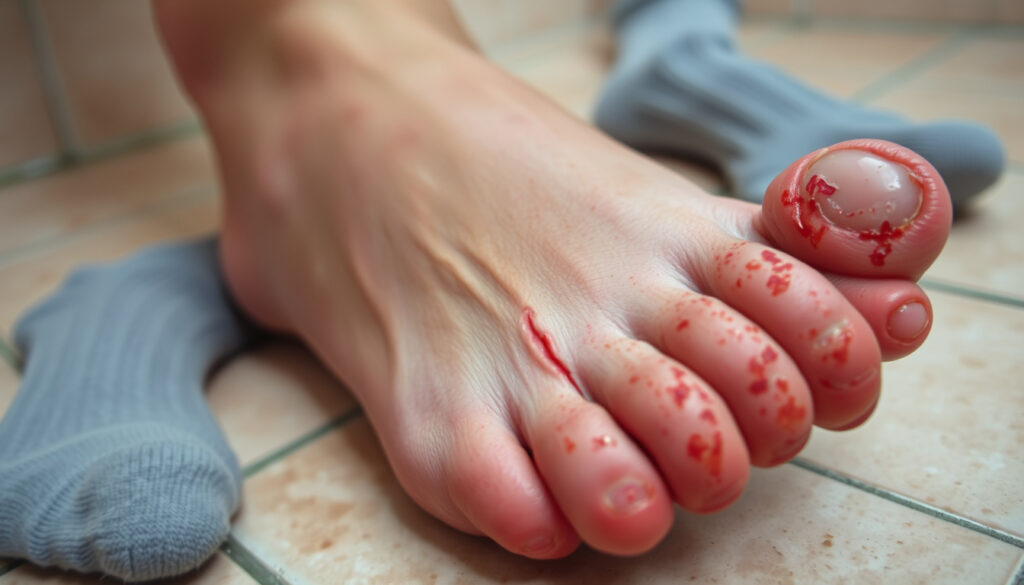
What Is Athlete’s Foot? Causes, Symptoms, and Treatment
You step out of the shower and notice that familiar itch between your toes — that tingle could be athlete’s foot, a common fungal infection affecting millions each year. With the right approach, you can treat it and keep it from coming back by understanding how it spreads, what to look for, and the treatments that actually work.
Caused by: Dermatophyte fungi, most commonly Trichophyton rubrum · Prevalence: Affects 15-25% of the population at some point · Symptoms: Itching, burning, cracked and peeling skin between the toes · Treatment success: Topical terbinafine cures 70-80% of cases within 1-2 weeks
Quick snapshot
- A common fungal infection of the feet (Cleveland Clinic (medical center))
- Medically called tinea pedis (MedlinePlus (National Library of Medicine))
- Caused by dermatophyte fungi (CDC (U.S. public health agency))
- Itchy, burning sensation between toes (Cleveland Clinic (medical center)) (Johns Hopkins Medicine (academic medical center))
- Peeling, cracked skin (Johns Hopkins Medicine (academic medical center))
- Blisters and raw skin possible (MedlinePlus (National Library of Medicine)) (Johns Hopkins Medicine (academic medical center))
- Direct skin-to-skin contact (Cleveland Clinic (medical center))
- Contaminated floors, towels, shoes (CDC (U.S. public health agency))
- Warm, damp environments (Johns Hopkins Medicine (academic medical center))
- OTC antifungal creams (clotrimazole, terbinafine) (MedlinePlus (National Library of Medicine)) (StatPearls (NCBI Bookshelf, clinical reference))
- Keep feet dry and clean (StatPearls (NCBI Bookshelf, clinical reference))
- Severe cases need oral medication (MedlinePlus (National Library of Medicine)) (StatPearls (NCBI Bookshelf, clinical reference))
Six key facts, one pattern: athlete’s foot is driven by fungal growth in warm, moist conditions — and breaking that cycle is the key to treatment.
| Label | Value |
|---|---|
| Medical name | Tinea pedis (CDC (U.S. public health agency)) |
| Common cause | Trichophyton rubrum fungus (Cleveland Clinic (medical center)) |
| Peak season | Summer and warm months (Harvard Health (university medical publisher)) |
| Average treatment duration | 1-2 weeks for topical creams (MedlinePlus (National Library of Medicine)) |
| Contagious period | Until infection is fully cleared (CDC (U.S. public health agency)) |
| Treated with | Topical antifungals (first line) (MedlinePlus (National Library of Medicine)) |
How does a person get athlete’s foot?
What causes athlete’s foot?
- The infection is caused by dermatophyte fungi — most often Trichophyton rubrum (Cleveland Clinic (medical center)). These fungi feed on keratin, the protein in dead skin cells.
- They thrive in warm, moist environments like locker rooms, swimming pools, and showers (Johns Hopkins Medicine (academic medical center)).
- Risk factors include sweaty feet, tight footwear, and walking barefoot in communal wet areas (StatPearls (NCBI Bookshelf, clinical reference)).
Why is it called athlete’s foot?
The name stuck because the condition is especially common among athletes — people who sweat heavily and spend time in locker rooms and showers (Harvard Health (university medical publisher)). The fungus spreads easily in exactly the environments where athletes train and change. The medical term, tinea pedis, is less catchy but more precise.
Can athlete’s foot spread to other parts of the body?
Yes. If you scratch the infected area and touch other body parts, the fungus can spread — to your hands (tinea manuum), groin (jock itch), or even your scalp (Cleveland Clinic (medical center)). Using separate towels for your feet and washing your hands after touching the affected skin are simple ways to limit the spread (StatPearls (NCBI Bookshelf, clinical reference)).
Athlete’s foot doesn’t just happen in athletes — anyone with sweaty feet in tight shoes creates the perfect fungal incubator. The infection recurs because the environment stays favorable even after treatment.
The implication: any warm, moist environment on the foot can sustain the infection, not just communal showers.
What are 5 symptoms of athlete’s foot?
What does athlete’s foot look like?
- Itching, stinging, and burning between the toes (Cleveland Clinic (medical center))
- Cracking, peeling, and scaling skin (Johns Hopkins Medicine (academic medical center))
- Blisters that may weep fluid (MedlinePlus (National Library of Medicine))
- Raw skin or ulcers in severe cases (Johns Hopkins Medicine (academic medical center))
- A musty odor or thickened toenails if untreated (Cleveland Clinic (medical center))
Does athlete’s foot go away by itself?
Rarely. Without treatment, the fungus usually persists and can spread to other parts of the foot or to other people (StatPearls (NCBI Bookshelf, clinical reference)). The infection may appear to settle down in cool, dry weather, but the fungus often remains dormant and sprouts again when conditions get warm and damp. Medical guidelines from the CDC (U.S. public health agency) recommend treatment for all cases.
If athlete’s foot doesn’t respond to two weeks of over-the-counter creams or if you have diabetes, see a healthcare provider. Left untreated, it can lead to secondary bacterial infections and chronic skin breakdown.
What this means: early treatment is essential to avoid complications, especially for those with underlying health conditions.
What is the best cure for athlete’s foot?
What clears an athlete’s foot fast?
The fastest approach is a topical antifungal cream containing terbinafine (Lamisil) or clotrimazole, applied once or twice daily for at least one week (MedlinePlus (National Library of Medicine)). Terbinafine is reported to cure 70-80% of cases within 1-2 weeks. For faster results, combine the cream with keeping your feet as dry as possible and changing socks more than once a day.
What kills athlete’s foot instantly?
Nothing kills the fungus instantly — it takes days of consistent treatment (Cleveland Clinic (medical center)). Some people use hydrogen peroxide or rubbing alcohol, but these can irritate cracked skin and don’t reach the deeper layers where fungi live. Stick with proven antifungals.
Can Sudocrem get rid of athlete’s foot?
Sudocrem is not an antifungal medication. Its zinc oxide base may soothe irritated skin and keep the area dry, but it doesn’t kill dermatophytes (American Academy of Dermatology (professional dermatology association)). Use it only as a complement to a real antifungal, not a replacement.
What naturally kills fungus on feet?
Some natural remedies show antifungal activity in lab studies, but clinical evidence is limited. Tea tree oil, apple cider vinegar, and garlic are often mentioned (StatPearls (NCBI Bookshelf, clinical reference)). However, the American Academy of Dermatology (professional dermatology association) advises that OTC creams are more reliable and less likely to cause skin irritation.
How to cure athlete’s foot in one day?
It’s not possible to cure a fungal infection in 24 hours (Johns Hopkins Medicine (academic medical center)). Even with strong topical treatment, the fungus is present beneath the skin surface. What you can do in one day: apply an antifungal cream, thoroughly wash and dry your feet, disinfect your shower floor, and switch to clean, breathable socks to start the recovery process.
The pattern: reliable treatments exist, but consistent application and hygiene are crucial for success.
How to break the reinfection cycle
The reason athlete’s foot keeps coming back is simple: the fungus lives on surfaces you touch daily — floors, shoes, towels, even bed sheets. Follow these steps to stop the cycle:
- Wash and dry feet thoroughly every day, especially between the toes (StatPearls (NCBI Bookshelf, clinical reference)).
- Apply antifungal cream to the entire affected area and a margin of healthy skin around it, even after symptoms seem gone (MedlinePlus (National Library of Medicine)).
- Change socks daily — or twice a day if feet are sweaty. Choose moisture-wicking materials (StatPearls (NCBI Bookshelf, clinical reference)).
- Alternate shoes so each pair has at least 24 hours to dry out (American Academy of Dermatology (professional dermatology association)).
- Disinfect floors and showers in your home. Wear flip-flops in communal wet areas (CDC (U.S. public health agency)).
- Don’t share towels, linens, or shoes with someone who has an active infection (American Academy of Dermatology (professional dermatology association)).
The trade-off: treating a single outbreak is fast, but preventing recurrence demands a change in daily habits. The effort pays off — once you break the fungal lifecycle, the infection rarely returns.
What we know and what’s still unclear
Confirmed facts
- Athlete’s foot is caused by dermatophyte fungi (CDC (U.S. public health agency)).
- Topical antifungals are effective for most cases (MedlinePlus (National Library of Medicine)).
- It is contagious through direct contact and contaminated surfaces (Cleveland Clinic (medical center)).
What’s unclear
- Whether natural remedies like tea tree oil are as effective as OTC creams — most studies are small or lab-based (StatPearls (NCBI Bookshelf, clinical reference)).
- Why some people are more prone to chronic infections — genetics and immune factors may play a role, but evidence is limited (Johns Hopkins Medicine (academic medical center)).
- The exact role of immune system deficiencies in recurrent infections is not fully understood.
“Athlete’s foot is a very common fungal infection that usually begins between the toes. It occurs most often in people whose feet sweat heavily or who wear tight shoes.”
“You can treat athlete’s foot with over-the-counter antifungal creams, sprays, or powders. If these don’t work, your GP may prescribe stronger treatments.”
“To prevent athlete’s foot, keep your feet clean and dry, especially between the toes. Wear sandals or flip-flops in public showers or locker rooms.”
American Academy of Dermatology (professional dermatology association)
The catch: even authoritative sources agree that prevention hinges on moisture control and hygiene, not just medication.
Bottom line
For anyone dealing with athlete’s foot, the choice is clear: treat it thoroughly with an OTC antifungal for at least a week, and change your hygiene habits to keep feet dry and surfaces fungus-free. Or risk repeated infections that last for months or spread to other parts of your body. Consistency with treatment and dry-foot habits breaks the fungal cycle.
Related reading: Trapped Nerve in Neck – Symptoms, Causes, Treatments · Signs of Mouth Cancer: Early Symptoms, Warning Signs & Self-Test
stcloudfootankle.com, health.harvard.edu, youtube.com, apma.org
Understanding what athlete’s foot is can help you recognize athletes foot causes and symptoms before the infection spreads.
Frequently asked questions
Can foot fungus live on bed sheets?
Yes. Fungi can survive on fabrics, including sheets and towels, for days to weeks (American Academy of Dermatology (professional dermatology association)). Wash bedding in hot water (at least 130°F / 54°C) to kill the spores.
Is athlete’s foot contagious?
Yes. It spreads through direct skin contact and contaminated surfaces like floors, towels, and shoes (Cleveland Clinic (medical center)).
Can athlete’s foot spread to the groin?
Yes. This is called tinea cruris (jock itch). The same fungus that infects the feet can move to the groin via hands or towels (StatPearls (NCBI Bookshelf, clinical reference)).
How to prevent athlete’s foot after treatment?
Keep feet dry, wear breathable shoes, use flip-flops in public showers, and don’t share towels or shoes (CDC (U.S. public health agency)).
What happens if athlete’s foot is left untreated?
It can spread to other body parts, cause painful cracks and bacterial infections, and become chronic (Johns Hopkins Medicine (academic medical center)). People with diabetes are at higher risk for complications.
How long does athlete’s foot take to heal with treatment?
With topical antifungal creams, improvement is usually seen within a few days, but full clearance takes 1-2 weeks (MedlinePlus (National Library of Medicine)).
More related posts
 England Cricket Score Today Live Score – Live Updates
 London School of Economics: Rankings, Admissions & Fees
 Peter Thomas Roth Instant FIRMx Eye: Tightener Review & Guide
 Snakes and Ladders Abingdon: Reviews, Prices, Hours & Menu
 Judy Loe: Career, Husband, Daughter, and Cause of Death
 Easy Egg Fried Rice Recipe – How to Make the Best at Home
 Passport Photos Near Me: Compare Prices & Locations 2025
 Patrick Trueman: EastEnders Biography and Family Guide