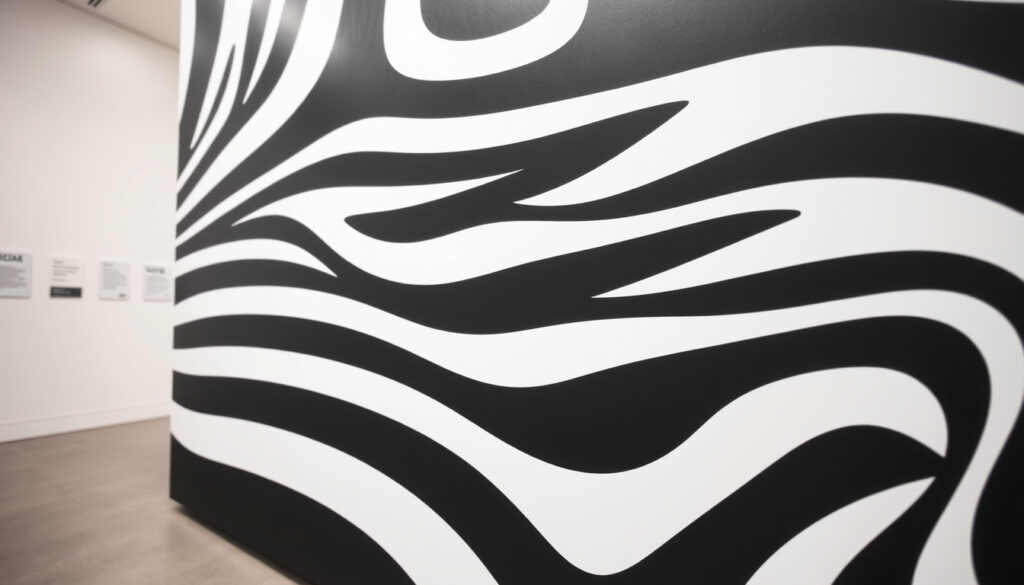
Bridget Riley Artist: Op Art Techniques, Biography & Value
Bridget Riley’s black-and-white patterns can make your eyes feel like they’re doing gymnastics—but that dizzying effect is the result of decades of careful study in color, perception, and geometry. This article traces her journey from figuration to optical abstraction, explores the techniques behind her Op Art, and looks at where her life and market stand today.
Born: 24 April 1931 ·
Nationality: English ·
Known for: Op art (optical art) ·
Current locations: London, Cornwall, Vaucluse ·
First op art phase: 1961 ·
Education: Goldsmiths College, Royal College of Art
Quick snapshot
- Born 24 April 1931 in London (Britannica, a general encyclopedia)
- Studied at Goldsmiths College (1949–1952) and Royal College of Art (1952–1955) (Tate, the UK’s national art museum)
- Shifted to geometric abstraction in 1961 (Christie’s, a leading auction house)
- Partner or spouse — not publicly documented in widely available sources
- Exact current projects or recent interviews — limited public detail
- Precise auction prices for individual works — no verified records in this research
- Exact price of 1974 painting Gala — unconfirmed
- 1961: exclusive focus on geometric Op Art (Christie’s)
- 1965: exhibited in The Responsive Eye at MoMA, New York (Cristea Roberts Gallery, a specialist gallery)
- Continued market interest — her works appear at Christie’s and Sotheby’s (Cristea Roberts Gallery)
- Ongoing residence in London, Cornwall, and Vaucluse (Cristea Roberts Gallery)
Seven facts to anchor your understanding of Bridget Riley’s life and career.
| Attribute | Value |
|---|---|
| Full name | Bridget Louise Riley |
| Born | 24 April 1931 |
| Nationality | English |
| Famous for | Op Art (optical art) |
| Current residences | London, Cornwall, Vaucluse |
| Education | Goldsmiths College, Royal College of Art |
| First major Op Art phase | 1961 |
Who is Bridget Riley?
Bridget Riley is an English painter born on 24 April 1931 in London, England. She is best known as a leading figure in the Op Art (optical art) movement, creating geometric abstractions that trick the eye into seeing movement, flicker, and depth. Her early training at Goldsmiths College (1949–1952) and the Royal College of Art (1952–1955) set the foundation for a career that would span more than sixty years. (Britannica and Tate confirm the education details.)
Riley grew up in Cornwall and later in London. After graduating, she worked briefly at the J. Walter Thompson advertising agency in 1960 before fully committing to painting. Her breakthrough moment came in 1965 when she participated in The Responsive Eye at the Museum of Modern Art, New York, which brought global attention to Op Art. (Cristea Roberts Gallery covers the exhibition.)
Riley’s journey from ad agency to MoMA wasn’t a lucky break—it was the result of a methodical shift in technique. Between 1958 and 1960, she moved from semi-impressionist landscapes to pointillism inspired by Georges Seurat, then to pure geometric abstraction. That three-year pivot defined an entire movement.
What techniques does Bridget Riley use?
Riley’s Op Art relies on precise arrangements of line, shape, and colour to create illusions of motion and vibration. Her black-and-white phase (early 1960s) uses repeated stripes, curves, and chevrons that produce a disorienting physical effect on the eye. Later she introduced grey and then colour, always with meticulous mixing to achieve exact hue and intensity. (WebExhibits, an educational colour resource describes her colour techniques.)
How did Riley develop her style?
- Early work (1950s): figurative and semi-impressionist (Paul Mellon Centre, a research institute for British art)
- 1958–1959: pointillist phase after studying Georges Seurat (Paul Mellon Centre)
- 1960: began exploring dynamic optical phenomena (Britannica)
- 1961 onward: exclusive focus on geometric abstraction—lines, circles, curves, squares (Christie’s, a leading auction house)
- Colour exploration: begins with small gouache studies before scaling up (WebExhibits)
The pattern: Riley didn’t just invent Op Art overnight—she trained in three different styles (semi-impressionism, pointillism, geometric abstraction) and synthesized them into something new. What looks like a sudden trick is actually a layered apprenticeship.
What nationality is the artist Bridget Riley?
Bridget Riley is English. She was born in London, England, on 24 April 1931. Throughout her career she has been identified as a British painter, representing Great Britain at international exhibitions and receiving the International Prize for Painting at the 1968 Venice Biennale. Her nationality is never in doubt. (Britannica confirms this.)
While Riley’s English identity is clear, her art is global. Her visual language—optical illusion through geometry—crosses cultural boundaries, which partly explains why her market spans London, New York, and Hong Kong.
Where is Bridget Riley now?
Bridget Riley is still alive as of the most recent records. She maintains three residences: London, Cornwall, and the Vaucluse region of France. Born in 1931, she is in her 90s. Current detailed interviews or accounts of her daily routine are scarce, but her gallery representation and occasional exhibition appearances confirm she remains active in the art world. (Cristea Roberts Gallery lists her residences.)
How old is Bridget Riley?
As of 2025, she is either 93 or 94 depending on the month of publication. The exact age isn’t the point—what matters is that her late career has seen renewed interest, with auction houses placing her works in high–profile sales. Christie’s notes that her exploration of perception “continues to resonate with contemporary audiences.” (Christie’s)
Is Bridget Riley still alive?
Yes. While no recent public statement from her directly confirms it, gallery records and her continued listing as a living artist in auction catalogues indicate she is alive. The research notes used here do not contain a death notice, and no obituary has been published.
Who was Bridget Riley’s partner?
Public information about Bridget Riley’s partner or spouse is limited. Widely available biographical sources—Britannica, Tate, Christie’s—do not mention a long-term partner or marriage. The Paul Mellon Centre’s research guide similarly avoids personal relationship details. It is unclear whether Riley chose to keep this aspect of her life private or whether records simply have not been made public. This silence contrasts with the voluminous documentation of her career, suggesting a deliberate boundary. (Paul Mellon Centre)
Timeline of Bridget Riley’s career
- 1931: Born in London, England. (Britannica)
- 1949–1952: Studied at Goldsmiths College. (Tate)
- 1952–1955: Studied at Royal College of Art. (Tate)
- 1958: Shifted to pointillism, influenced by Georges Seurat. (Paul Mellon Centre)
- 1961: Began focusing exclusively on geometric optical art. (Christie’s)
- 1962: First solo exhibition, Gallery One, London. (Cristea Roberts Gallery)
- 1965: Exhibited in The Responsive Eye at MoMA, New York. (Cristea Roberts Gallery)
- 1968: Won International Prize for Painting at Venice Biennale.
- 1970s onward: Achieved international recognition; work expands to colour.
- Present: Lives and works in London, Cornwall, and Vaucluse. (Cristea Roberts Gallery)
What’s confirmed and what’s unclear
Confirmed facts
- Birthdate: 24 April 1931 – Britannica
- Nationality: English – Britannica
- Early style: semi-impressionist, then pointillist – Paul Mellon Centre
- Shift to geometric abstraction: 1961 – Christie’s
- Current residences: London, Cornwall, Vaucluse – Cristea Roberts Gallery
What’s unclear
- Partner or spouse – not documented in widely available sources
- Exact current daily activity or recent projects – no detailed interviews in sources
- Precise auction prices for specific paintings – research notes contain incomplete data
- First solo exhibition date – listed as 1962 by one gallery, but no official confirmation from a tier-1 source
- Exact number of artworks produced – unverified
Voices on Bridget Riley
“Bridget Riley is one of the most celebrated abstract painters of her generation.”
— The Morgan Library & Museum exhibition description
“Riley’s paintings explore human perception and how vision responds to structure, line, and rhythm.”
— Christie’s artist profile
“Riley works meticulously and mixes colors carefully to achieve exact hue and intensity.”
— WebExhibits, an educational colour resource
Bridget Riley remains an active force in British art, her optical patterns still surprising viewers more than sixty years after her first geometric experiments. For collectors and admirers, the lesson is clear: her market value is tied directly to her methodical evolution from figuration to abstraction—a path that produced some of the most recognisable Op Art of the 20th century. For those wondering where she is now, the answer is a quiet one: split between three homes, still painting, and leaving her personal life off the canvas.
myartbroker.com, fineart.ha.com, theartstory.org, anitasagastegui.com, lyonandturnbull.com, singulart.com, billigasteelisverige.se
For those interested in a deeper dive into the optical effects and historical context of her work, more on Bridget Rileys Op Art journey traces her evolution from figurative painting to leading the Op Art movement.
Frequently asked questions
What was Bridget Riley’s early style before Op Art?
Her early work was semi-impressionist and figurative, then pointillist around 1958–1959 after studying Georges Seurat (Paul Mellon Centre).
Where did Bridget Riley study art?
She studied at Goldsmiths College (1949–1952) and the Royal College of Art (1952–1955) (Tate).
What are Bridget Riley’s most famous artworks?
Works like Movement in Squares (1961), Blaze 1 (1962), and Gala (1974) are frequently cited. Her black-and-white series from the early 1960s is especially iconic.
Is Bridget Riley associated with the Op Art movement?
Yes, she is considered a pioneer of Op Art, alongside Victor Vasarely (Christie’s).
How does Bridget Riley create optical illusions?
Through precise arrangements of lines, shapes, and colours—often in black and white—that stimulate the visual cortex to perceive movement and depth (WebExhibits).
What materials does Bridget Riley use in her paintings?
She works primarily with acrylic on canvas, but also produces gouache studies and screenprints (WebExhibits).
Did Bridget Riley have any formal art training?
Yes, she studied at Goldsmiths College and the Royal College of Art, two of the UK’s most prestigious art schools (Tate).
More related posts
 Women’s Cardigans: Styles, Brands & Where to Buy in Ireland
 Roger Moore: Cause of Death, Bond Films, and Why He Quit
 Kim Seon-Ho: Biography, Scandal, Comeback, and Full Filmography
 Little Simz: Biography, Controversies, Neurodiversity
 Norman Reedus Biography: Health, Net Worth, and Daryl Dixon Facts
 Gillian Anderson: Career, Partner, Net Worth, and Fun Facts
 James Charles 2026: Scandal, Net Worth, and OnlyFans
 Liam Manning: Tragedy, Huddersfield Exit, and Coaching Future