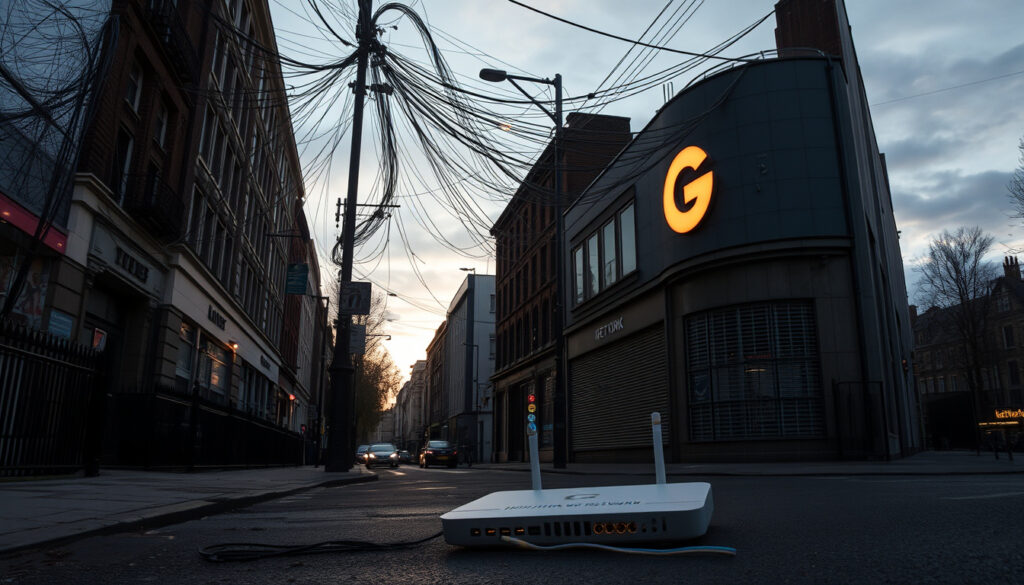
G Network Collapses Administration: London Broadband Crisis
It sounded like a bizarre reason for a broadband company to fall apart: rats chewing through fibre optic cables. But that, combined with nearly £300 million in debt, brought G.Network, a London‑based full‑fibre alt‑net, to the brink of administration in early 2026.
Debt at administration: £300 million ·
Administration date: 13 January 2026 ·
Failed acquisition by: Community Fibre ·
Current owner: FitzWalter Capital (debt specialist) ·
Number of customers: Not publicly disclosed ·
Cable damage cause: Rats gnawing through fibre cables
Quick snapshot
- Full fibre broadband provider in London (Scottish Financial News)
- Founded around 2015 (Scottish Financial News)
- Invested over £1bn (Tom’s Hardware)
- Entered administration Jan 2026 (Tom’s Hardware)
- £300m debt (Tom’s Hardware)
- Rat damage to cables (IndexBox)
- Failed acquisition by Community Fibre (Data Center Dynamics)
- Vulture fund intervention (Scottish Financial News)
- Service continues for now
- Switching possible
- Monitor official announcements
- Early termination fees may apply
- Alt-net sector under pressure (Tom’s Hardware)
- CityFibre redundancies (Tom’s Hardware)
- Potential consolidation (Tom’s Hardware)
- BT and Virgin Media still dominant (Tom’s Hardware)
Eight key facts at a glance, from company identity to the immediate aftermath.
| Fact | Value |
|---|---|
| Company | G.Network |
| Service | Full-fibre broadband (alt-net) |
| Geographic focus | London, UK |
| Administration notice filed | 13 January 2026 |
| Estimated debt | £300 million |
| Previous acquisition attempt | Community Fibre (failed) |
| Current controller | FitzWalter Capital (debt specialist) |
| Reported cause | Rat damage to fibre cables and high debt |
Who Is G.Network?
G.Network is a London‑based “alt‑net” broadband provider that invested heavily in full‑fibre infrastructure to compete against BT and Virgin Media in the capital. The company poured over £1 billion into a city‑wide fibre rollout, aiming to offer faster, symmetrical speeds to homes and businesses. But by early 2026, after accumulating roughly £300 million in debt and facing repair costs from rodent‑damaged cables, G.Network became the latest casualty in the UK’s alternative‑network sector. Debt specialist FitzWalter Capital now controls the company through an administration process similar to Chapter 11 in the United States (Tom’s Hardware (tech industry outlet)).
The implication: G.Network’s rise and fall mirrors the broader alt‑net gamble – huge capital outlay, tiny subscriber base, and razor‑thin margins.
Why Did G.Network Collapse Into Administration?
What caused G.Network’s financial troubles?
The company filed a notice to enter administration on 13 January 2026 after a rescue deal collapsed. The primary financial cause was a debt pile of roughly £300 million (Tom’s Hardware). But the final straw was the state of its physical network: rats had gnawed through fibre optic cables across London, creating an expensive repair bill that scared off potential buyers. Community Fibre, the rival alt‑net that had been negotiating a rescue, walked away after due diligence revealed the extent of rodent damage. Community Fibre chief executive Graeme Oxby reportedly said, “Rodents like ducts and they like fibres which are very tasty” (IndexBox (industry market analysis)).
A network valued at over £1 billion on paper became unsellable because the cost of fixing chewed cables was too high, leaving debt holders in control.
How did rodent damage affect operations?
The rodent issue wasn’t a minor inconvenience – it fundamentally altered the risk profile of G.Network’s infrastructure. The company had to allocate significant resources to identify and repair damaged fibre ducts across London, and the recurring nature of the problem (rodents are attracted to the ducts and the cable coating) made ongoing maintenance unpredictable. The network was described as a high‑risk asset because of the extensive rodent damage to fibre infrastructure (Scottish Financial News (financial & business reporting)).
- Repair costs pushed operational expenses beyond what G.Network could sustain with its ~25,000 paying subscribers (Tom’s Hardware).
- Customer churn increased as service reliability suffered.
- Potential acquirers requested expensive technical assessments before even considering a deal – Community Fibre reportedly did not even conduct one before ruling out the acquisition (Tom’s Hardware).
Who Will Buy G.Network?
What is FitzWalter Capital?
FitzWalter Capital is a London‑based debt‑specialist investment firm. It stepped in as the administrator after the Community Fibre deal collapsed, effectively taking control of G.Network to protect its debt position. The firm is described by some outlets as a “vulture fund” that forces distressed portfolio companies into administration rather than accepting losses on its loans (Scottish Financial News). Now controlling G.Network, FitzWalter will either sell the business as a going concern or break it up.
Is Community Fibre still interested?
Community Fibre walked away from the deal after due diligence revealed the full cost of repairing rodent‑damaged cables. The company had been seen as the natural buyer – both are London‑focused alt‑nets with overlapping infrastructure (Data Center Dynamics (data centre & telecom news)). No other buyer has publicly emerged, leaving FitzWalter to proceed with a formal sale process. The eventual buyer could be another alt‑net, an infrastructure investor, or a private equity fund betting on a turnaround.
If no buyer materialises, FitzWalter may write down the debt and liquidate assets, which would leave London’s broadband competition in even fewer hands.
The outcome of the sale process will determine whether G.Network survives as an independent entity or gets absorbed into a larger player.
What Happens to Customers and Services?
Will my broadband stop working?
Administration gives G.Network temporary protection from creditors while operations continue. Customers should not see an immediate interruption of service. Administrators will seek to keep the network running so it can be sold as a viable asset. However, long‑term stability depends on a successful sale or restructuring.
Can I switch providers?
Yes, switching is possible, but early termination fees may apply depending on your contract terms. Most alt‑net contracts in the UK have a 12‑or‑24‑month minimum term, and exiting early typically incurs a penalty. Customers should check their contract and weigh the cost of leaving against the uncertainty of continued service under administration.
What about my contract?
Contracts remain in force during administration. Administrators usually honour existing terms while seeking a buyer. If the company is sold, the new owner may change terms later. Customers are advised to monitor official communications from G.Network and the administrator for any updates on billing, service continuity, or contract changes.
The trade‑off: staying with G.Network avoids immediate switching fees but carries the risk of eventual disruption if the network is not maintained or sold.
What Does This Mean for the UK Broadband Market?
How does G.Network’s collapse affect alt‑nets?
G.Network’s failure is a warning signal for other alt‑nets with high debt and operational fragility. The UK’s alternative broadband sector has expanded rapidly on cheap debt, but rising interest rates and slower‑than‑expected customer acquisition have left several players exposed. CityFibre, another major alt‑net, has already made redundancies to shore up its finances (Tom’s Hardware).
Will this lead to consolidation?
The market may see more consolidation or retreat by aggressive investors. BT and Virgin Media remain dominant, and government support for alt‑nets is uncertain. The collapse of G.Network – driven partly by a bizarre physical cause – will make private equity and debt funds more cautious about funding new builds, especially in areas where infrastructure condition is hard to assess.
- CityFibre redundancies signal cost pressure across the sector.
- Community Fibre’s walkaway suggests even well‑funded peers are wary of taking on damaged assets.
- The alt‑net model – build first, acquire customers later – looks increasingly fragile in a higher‑interest environment.
Why this matters: London’s broadband market, already dominated by a handful of players, could become less competitive if alt‑nets continue to fail or are absorbed by larger incumbents.
Timeline signal
- – G.Network founded as London‑focused alt‑net broadband provider. (Scottish Financial News)
- – Invested over £1bn in London fibre rollout, grew customer base.
- – Financial troubles emerge; rats gnaw through fibre cables causing costly repairs. (IndexBox)
- – Negotiations with Community Fibre for acquisition. (Data Center Dynamics)
- – G.Network files notice to put company into administration.
- – FitzWalter Capital, a debt specialist, takes control as administrator.
- – Mirror reports G.Network ‘plunges into administration’ with £300m debt and rat damage.
What we know vs what remains unclear
Confirmed facts
- G.Network entered administration on 13 January 2026. (Tom’s Hardware)
- Debt estimated at £300 million. (Tom’s Hardware)
- Rats damaged fibre cables. (IndexBox)
- Community Fibre acquisition fell through. (Data Center Dynamics)
- FitzWalter Capital is the debt specialist involved. (Scottish Financial News)
What’s unclear
- Exact number of customers affected.
- Future ownership (sale to another company or restructuring).
- Whether service will be disrupted long‑term.
- The full financial detail of the debt structure.
Quotes from the coverage
“G.Network had accumulated £300 million in debt and rats gnawed through fibre cables.”
Mirror Money (editorial)
“FitzWalter Capital is a ‘vulture fund’ that forced the company into administration.”
Yahoo Finance (financial news site)
“The potential deal with Community Fibre fell through due to an unspecified issue, later identified as rodent damage.”
Fibreprovider.net (industry blog)
The story of G.Network is a reminder that even in the digital world, physical infrastructure matters. For London’s broadband market, the choice is becoming clearer: either incumbents absorb these struggling alt‑nets and reduce competition, or the sector learns to price rodent risk into its business models. For customers, the immediate advice is to stay informed and evaluate your contract without panic – but don’t ignore the warning signs.
For a full breakdown of what this means for customers, see G Networks administration details.
Frequently asked questions
How long will G.Network be in administration?
Administration typically lasts several months while the administrator seeks a buyer or restructuring plan. There is no set deadline, but creditors will push for a speedy resolution.
Who is the appointed administrator for G.Network?
The administrator is FitzWalter Capital, the debt specialist that already controlled G.Network’s loans. They are managing the process to recover as much value as possible.
Will G.Network customers lose their service during administration?
Service is expected to continue uninterrupted for now. Administrators want to keep the network running to preserve its sale value.
Can I get a refund if I cancel my G.Network contract?
Refunds depend on contract terms. Early termination fees may apply. Check your contract or contact the administrator for clarification.
What alternatives are available for G.Network customers?
Alternatives include BT, Virgin Media, Community Fibre (if in your area), and other smaller alt‑nets. Use comparison sites to see what’s available at your address.
Is G.Network the only alt‑net to collapse recently?
Other alt‑nets are under financial pressure. CityFibre has made redundancies, and several smaller operators are reviewing their debt structures.
How can I contact G.Network customer support now?
Existing customer support channels should still work. Check G.Network’s website for updates, but note that response times may slow during administration.
Related reading: UK Interest Rate Predictions 2026-2030: Homeowner Guide (macroeconomic context for G.Network’s debt burden) and Tesla UK Sales Slump – Figures, Causes and Recovery Outlook (parallel UK corporate distress story).
More related posts
 Ben Aldridge: Age, Movies, TV Shows, and Full Biography
 Arthur Ashe: Biography, Tennis Career, and Activism
 Ronnie O’Sullivan Net Worth – 2025 Prize Money Breakdown
 Shaun Ryder: Diagnoses, Sobriety, Wife, and Kids
 Should You Pop a Blister? Expert Advice & Safe Drainage Steps
 Axel Rudakubana: Sentencing, Inquiry, and Missed Warnings
 Aviva Zero Contact Number – Official Phone and Support Guide
 Dame Kelly Holmes: Biography, Net Worth, Army Rank, Relationship, and Health