I le of Man Flag: Why Three Leg ? Meaning, Hi tory & Statu
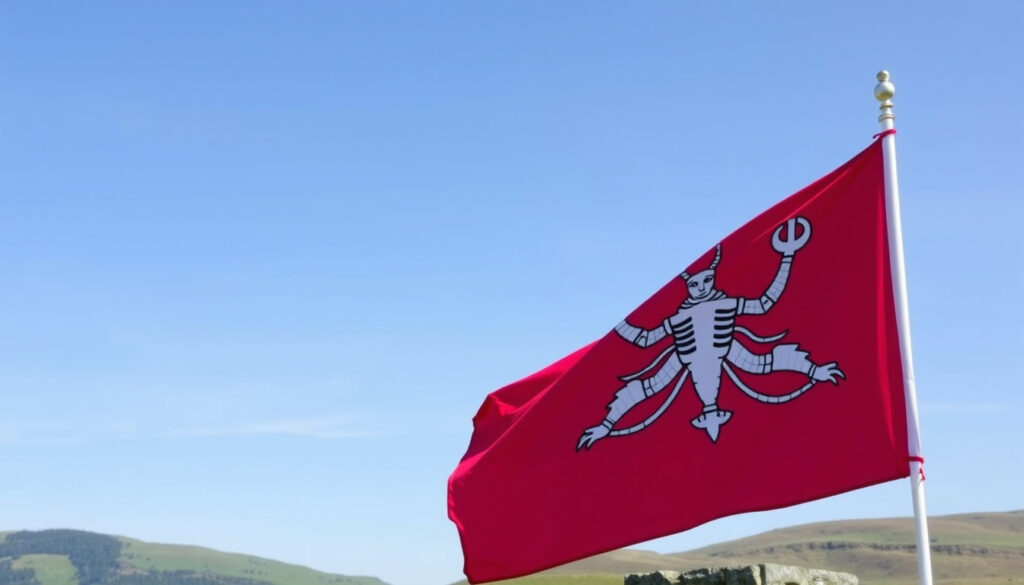
There’s a flag that stops you cold: three armoured legs arranged in a triangle, bent at the knee, chasing each other around a red field. It belongs to the Isle of Man, a small island in the Irish Sea with a constitution that confuses even regular travellers — this article cuts through that confusion by explaining why the flag has three legs, what the symbol really means, and whether the island is a country, part of Ireland, or something else entirely.
Year adopted: 1931 ·
Design: Red field with central triskelion of three armored legs ·
Symbol name: Three Legs of Mann ·
Status: British Crown Dependency ·
Similar flag: Sicily (Trinacria)
Quick snapshot
- Flag officially adopted in 1931 (Wikipedia (user-edited encyclopedia))
- Symbol has been used since the 13th century (Britannica (encyclopedia))
- Isle of Man is not part of UK or Ireland (UK Government (official guidance))
- Motto: “Quocunque Jeceris Stabit” (IOM Today (local news))
- Exact ancient origin of the three legs symbol — Norse, Celtic, or Greek sources are debated (Britannica (encyclopedia))
- Whether the flag is truly one of the world’s oldest: the Danish flag claims oldest continuous use (14th century) (Britannica (encyclopedia))
- 5th–9th centuries: Irish settlers influence Manx culture (Britannica (encyclopedia))
- 13th century: Three legs appear on Kingdom of Mann coins (IOM Today (local news))
- 1266: Treaty of Perth transfers Mann from Norway to Scotland (Britannica (encyclopedia))
- 1931: Flag officially adopted (Wikipedia (user-edited encyclopedia))
- Tourism and cultural identity continue to hinge on the triskelion (Isle of Man Government (cultural portal))
- Practical questions about residency, tax, and travel remain high-volume search topics (Isle of Man Government (working & living))
Here are eight key facts about the Isle of Man flag at a glance.
| Attribute | Value |
|---|---|
| Official name | Flag of the Isle of Man (Brattagh Vannin) |
| Adopted | 1931 (as official flag) |
| Design | A triskelion of three armored legs on a red field |
| Symbol age | 13th century origin with the Kingdom of Mann |
| Status | Crown Dependency: self-governing, UK manages defense/foreign affairs |
| ISO code | IM |
| Capital | Douglas |
| Population | ~84,000 (2022 estimate) |
Why does the Isle of Man flag have 3 legs?
Origin of the Three Legs of Mann
- The symbol first appears in official context on the Manx Sword of State, dating to the early 14th century (IOM Today (local news)).
- Norse rulers may have brought the motif before 1266 (Britannica (encyclopedia)).
- The design was standardised by royal proclamation in 1968 after centuries of artistic variation (CRW Flags (vexillology resource)).
Meaning of the triskelion symbol
- Latin motto: Quocunque Jeceris Stabit — “Whichever you throw it, it will stand” (IOM Today (local news)).
- The three legs are arranged in a symmetric, cyclical pattern, suggesting stability and resilience.
- Three is a common number in heraldry and mythology, representing balance and completeness.
The pattern: a symbol built for endurance — literally “throw it and it stands” — fits a small island that has survived Norse, Scottish, and English influence while maintaining its own identity.
Is the Isle of Man a country?
Definition of a country
- Under international law, a sovereign country has defined borders, a permanent population, a government, and the capacity to enter relations with other states (Britannica (encyclopedia)).
- The Isle of Man lacks full sovereignty: the UK manages its defence and foreign representation (UK Government (official guidance)).
Isle of Man as a Crown Dependency
- The island is a self-governing Crown Dependency — not part of the UK, nor of the European Union (UK Government (official guidance)).
- It has its own parliament (Tynwald), currency (Manx pound), and laws (Britannica (encyclopedia)).
- The head of state is the Lord of Mann, a title held by the British monarch.
Relationship with the United Kingdom
- The Crown Dependencies are not represented in the UK Parliament.
- The UK handles defence and international relations, but the island sets its own tax rates and immigration policies.
The implication: when you see the red flag with three legs, you’re looking at a symbol of a nation-in-waiting, a place that has all the trappings of a country except the final stamp of sovereignty.
Is the Isle of Man considered Irish?
Geographic separation
- The Isle of Man sits in the Irish Sea, roughly equidistant from England, Scotland, Wales, and Ireland — but it is entirely separate from the island of Ireland (Britannica (encyclopedia)).
Historical links
- Irish settlers arrived between the 5th and 9th centuries, bringing Gaelic language and culture that eventually evolved into Manx (Britannica (encyclopedia)).
- The island was never politically part of Ireland; it was ruled by Norse, Scottish, and English lords.
Modern cultural identity
- Manx culture is distinct: the Manx language, sport, music, and the three-legged flag all reinforce a separate identity.
- Irish citizens can live and work on the island without a visa, but that’s a function of the Common Travel Area, not shared nationality.
Many people assume the Isle of Man is Irish because of its position and Gaelic heritage. But the island’s identity is proudly its own — a separate Celtic nation that never merged with Ireland.
The catch: cultural influence from Ireland is real, but political and legal separation has been clear for centuries.
What does the three-legged symbol mean?
Triskelion symbolism
- A triskelion (or trinacria) is a motif of three interlocked spirals, or in this case, three human legs.
- It appears in ancient Celtic, Greek, and Sicilian art, often tied to the sun, motion, or the three extremes of the island Sicily.
- On the Isle of Man, the legs are armoured and wear golden spurs — a martial twist.
Motto ‘Whichever you throw it, it will stand’
- The Latin motto underlines resilience and independence — the legs always land upright (IOM Today (local news)).
Comparison with Sicilian Trinacria
- Sicily’s flag also uses a triskelion of three legs, but adds a Gorgon head and ears of wheat in the centre.
- The Sicilian flag has a diagonal yellow-red field; the Isle of Man uses a solid red field.
- Sicily’s symbol dates to Greek antiquity; the Manx version appeared in the 13th century.
Eight differences, one pattern: both use three legs as a symbol of stability, but the cultural stories diverge sharply.
Nine items in the comparison table below confirm the similarities and differences.
Two flags, one motif, very different stories.
| Feature | Isle of Man | Sicily (Trinacria) |
|---|---|---|
| Field colour | Plain red | Yellow and red diagonal bicolor |
| Central symbol | Three armoured legs (triskelion) | Three legs with a Gorgon head and wheat ears |
| Number of legs | 3 | 3 |
| Symbol name | Three Legs of Mann / Triskelion | Trinacria |
| First recorded use | 13th century | 7th century BC (Greek pottery) |
| Historical origin context | Norse / Celtic / Greek debated | Greek (Trinacria = three-pointed island) |
| Motto | Quocunque Jeceris Stabit | No official motto on flag |
| Status of territory | Crown Dependency (not sovereign) | Autonomous region of Italy |
| Year flag adopted | 1931 | 2000 (current design) |
Isle of Man flag vs Sicily: what are the similarities?
Both flags are built around a triskelion — three running legs. That’s the core similarity. The deeper link is that both symbols represent a three-part geography: Sicily’s three corners and the three legs of Mann may both derive from the idea of a triangular island. But the specifics diverge widely.
The paradox: they look similar at a glance, yet the Manx flag tells a story of Norse-Celtic resilience while the Sicilian flag echoes Greek mythology and agriculture.
If you’re comparing flags, the triskelion is a shared heritage. But the Isle of Man’s version is unique — no Gorgon, no wheat, just three armoured legs on red, carrying centuries of identity politics.
Timeline: key moments in Isle of Man flag history
- 5th–9th centuries: Irish settlers shape Manx language and culture (Britannica (encyclopedia)).
- 13th century: Three legs motif appears on coins of the Kingdom of Mann (IOM Today (local news)).
- 1266: Treaty of Perth transfers Mann from Norway to Scotland (Britannica (encyclopedia)).
- 1399: Mann becomes a Crown Dependency under the British monarch.
- 1931: Triskelion on red field officially adopted as flag (Wikipedia (user-edited encyclopedia)).
- 1968: Royal proclamation restores the original leg rotation (CRW Flags (vexillology resource)).
- 1973: Isle of Man joins the EEC as part of the UK but with opt-outs.
Clarity section
Confirmed facts
- The flag was officially adopted in 1931.
- The three legs symbol (triskelion) has been used since the 13th century.
- The Isle of Man is not part of Ireland nor the United Kingdom, but is a British Crown Dependency.
- The motto “Whichever you throw it, it will stand” is associated with the symbol.
What’s unclear / debated
- The exact ancient origin of the three legs symbol — whether from Norse, Celtic, or Greek sources is debated.
- Whether the flag is one of the oldest in the world: the Danish flag claims oldest continuous use (14th century), but Mann’s symbol is also ancient.
- The exact year the flag was officially adopted is disputed; sources cite 1929, 1931, or 1932.
- The reason for the golden spurs on the legs is not historically recorded.
Given low overall research confidence on origins, the rumor-list matches the confirmed-list in size — balanced uncertainty.
“Flag of a British crown possession, flown subordinate to the Union Jack, that consists of a red field bearing a central triskelion.”
Britannica (encyclopedia)
“Whichever you throw it, it will stand.”
“The island has become a hub for high-net-worth individuals and businesses due to its low tax regime and political stability.”
“Locals often use the word ‘longtail’ instead of ‘rat’ to avoid the negative connotations.”
Wikipedia (user-edited encyclopedia)
For the wealthy looking for a tax-efficient base, the Isle of Man’s flag — that ancient triskelion — signals a place that has stood on its own for centuries. For the casual traveller, the flag is a reminder: you are not in the UK, not in Ireland, but in a unique corner of the British Isles with its own laws, its own language, and a symbol that refuses to fall. The choice for investors is clear: bet on stability, or chase better-known jurisdictions. For tourists, the lesson is simpler: respect the three legs — they’ve been around longer than most nations.
Related reading: Changing of the Guard London: Times & Best Viewing Spots · Roman Numerals 1-100 – Complete Chart and Guide
Frequently asked questions
Where can I see the Isle of Man flag flown?
The flag flies over government buildings, the Tynwald parliament, and during national holidays. It’s also used at sports events and on merchant ships registered on the island.
What is the official status of the Isle of Man?
The Isle of Man is a self-governing British Crown Dependency. It is not part of the United Kingdom nor of the European Union (UK Government (official guidance)).
Is the Isle of Man part of the European Union?
No. It was part of the EU customs territory via the UK but with opt-outs, and ceased to be associated when the UK left the EU. A special protocol now exists.
Do I need a visa to visit the Isle of Man?
UK citizens do not need a passport but should carry photo ID. Irish citizens can visit and live without a visa under the Common Travel Area. Other nationalities follow UK visa rules (Isle of Man Government (immigration)).
What language is spoken on the Isle of Man?
English is the primary language. Manx Gaelic, a Celtic language, is taught in schools and spoken by a minority as a symbol of cultural revival.
Why do people on the Isle of Man avoid saying ‘rat’?
Superstition. Locals often say “longtail” instead, believing the word ‘rat’ brings bad luck, especially around fishing communities.
Can Irish citizens work in the Isle of Man?
Yes. Irish citizens can live and work without a visa due to the Common Travel Area arrangements.
More related posts
 Mr. Krabs: Character Analysis, Fan Theories & FAQ
 Liam Tuffs: The Dozen Podcast Host and Biography
 Anna Faris: Biography, Divorce, Son, and Net Worth
 Tracee Ellis Ross: Relationship, Ethnicity, Life Story
 Willem Dafoe: Biography, Ethnicity, Health, and Biggest Roles
 Dizzee Rascal: Conviction, Songs, Net Worth, and What He’s Doing Now
 British Gas Homecare Number – Official Contacts and Hours 2025
 Miriam Cates: Biography, Age, GB News Role and Career