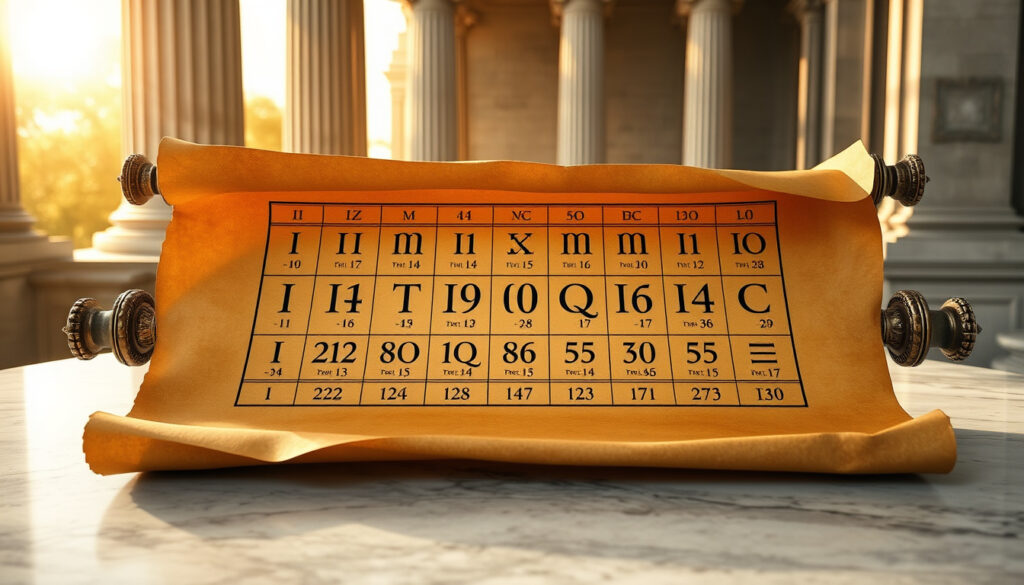
Roman Numerals 1-100 – Complete Chart and Guide
Roman numerals 1-100 form a foundational numeric system that originated in ancient Rome and remained in active use for over two millennia. This comprehensive guide presents the complete chart, explains the underlying rules, and provides practical resources for reading and writing numerals from I to C.
Understanding this system unlocks the ability to interpret clock faces, decipher Super Bowl numbering, navigate book chapters, and appreciate historical inscriptions. The seven symbols used throughout this range—I, V, X, L, and C—combine according to specific conventions that determine their collective value.
Roman Numerals 1-100: Complete Chart and List
The Roman numeral system employs five primary symbols to represent all values from 1 to 100. Each symbol holds a fixed value, and their arrangement determines the final number. The table below presents the complete correspondence between Arabic and Roman numerals across this range.
These four symbols form the foundation of the entire 1-100 system: I equals 1, V equals 5, X equals 10, and L equals 50. The fifth symbol, C, represents 100 and appears only at the upper end of this range.
| Arabic | Roman | Arabic | Roman | Arabic | Roman | Arabic | Roman |
|---|---|---|---|---|---|---|---|
| 1 | I | 26 | XXVI | 51 | LI | 76 | LXXVI |
| 2 | II | 27 | XXVII | 52 | LII | 77 | LXXVII |
| 3 | III | 28 | XXVIII | 53 | LIII | 78 | LXXVIII |
| 4 | IV | 29 | XXIX | 54 | LIV | 79 | LXXIX |
| 5 | V | 30 | XXX | 55 | LV | 80 | LXXX |
| 6 | VI | 31 | XXXI | 56 | LVI | 81 | LXXXI |
| 7 | VII | 32 | XXXII | 57 | LVII | 82 | LXXXII |
| 8 | VIII | 33 | XXXIII | 58 | LVIII | 83 | LXXXIII |
| 9 | IX | 34 | XXXIV | 59 | LIX | 84 | LXXXIV |
| 10 | X | 35 | XXXV | 60 | LX | 85 | LXXXV |
| 11 | XI | 36 | XXXVI | 61 | LXI | 86 | LXXXVI |
| 12 | XII | 37 | XXXVII | 62 | LXII | 87 | LXXXVII |
| 13 | XIII | 38 | XXXVIII | 63 | LXIII | 88 | LXXXVIII |
| 14 | XIV | 39 | XXXIX | 64 | LXIV | 89 | LXXXIX |
| 15 | XV | 40 | XL | 65 | LXV | 90 | XC |
| 16 | XVI | 41 | XLI | 66 | LXVI | 91 | XCI |
| 17 | XVII | 42 | XLII | 67 | LXVII | 92 | XCII |
| 18 | XVIII | 43 | XLIII | 68 | LXVIII | 93 | XCIII |
| 19 | XIX | 44 | XLIV | 69 | LXIX | 94 | XCIV |
| 20 | XX | 45 | XLV | 70 | LXX | 95 | XCV |
| 21 | XXI | 46 | XLVI | 71 | LXXI | 96 | XCVI |
| 22 | XXII | 47 | XLVII | 72 | LXXII | 97 | XCVII |
| 23 | XXIII | 48 | XLVIII | 73 | LXXIII | 98 | XCVIII |
| 24 | XXIV | 49 | XLIX | 74 | LXXIV | 99 | XCIX |
| 25 | XXV | 50 | L | 75 | LXXV | 100 | C |
Essential Insights for Reading the Chart
- Subtractive notation appears at 4 (IV), 9 (IX), 40 (XL), and 90 (XC)
- The symbols V, L, and D are never repeated in standard usage
- No Roman numeral includes a zero; this system predates the concept’s introduction to Europe
- Maximum three consecutive identical symbols appear before larger values
- Roman numerals read from left to right, with each symbol contributing its value
- The range from 1 to 10 uses only I, V, and X, while 11-39 adds X repeatedly
- The 40-100 range introduces XL, L, XC, and C for efficient representation
Basic Rules for Reading and Writing Roman Numerals
Mastering the Roman numeral system requires understanding five fundamental principles that govern how symbols combine and relate to one another. These rules ensure consistent interpretation across all values within the 1-100 range.
The Five Core Principles
First, the additive rule states that when a symbol appears after a symbol of equal or greater value, their values sum together. For example, VI equals 6 because V (5) precedes I (1), yielding 5 plus 1.
Second, the subtractive rule applies when a smaller value precedes a larger value. In such cases, the smaller amount subtracts from the larger. The pairs IV (4), IX (9), XL (40), and XC (90) follow this principle.
Third, repetition limitations prohibit more than three consecutive identical symbols. This means I can appear up to three times (III), but four would be written as IV rather than IIII.
Fourth, the symbols V, L, and D (50, 500) never repeat. Using VV for 10 would be incorrect; the proper form is X.
Fifth, the subtractive pairs always follow specific formations: only I can precede V and X; only X can precede L and C; only C can precede D and M. This historical convention has remained consistent since classical times.
The Roman numeral system contains no symbol for zero. Ancient Romans conducted arithmetic using separate counting tools rather than positional notation, making zero unnecessary for their computational methods.
Common Mistakes to Avoid
Incorrect forms frequently appear in casual contexts, particularly the use of IIII for 4 on clock faces—a practice rooted in aesthetic tradition rather than proper notation. The correct representation universally recognized in educational and formal settings is IV.
Another frequent error involves reversing subtractive pairs. The number 14 should read XIV (10 plus 4), not X-IV, which misapplies the subtraction principle. Similarly, 19 must be XIX (10 plus 9), never IXX.
Key Roman Numerals 1-10 and Beyond
The numerals from 1 to 10 establish the foundation for understanding the entire system. These ten values demonstrate every fundamental pattern that repeats throughout the 1-100 range.
Numbers 1 Through 10
| Arabic | Roman | Word |
|---|---|---|
| 1 | I | One |
| 2 | II | Two |
| 3 | III | Three |
| 4 | IV | Four |
| 5 | V | Five |
| 6 | VI | Six |
| 7 | VII | Seven |
| 8 | VIII | Eight |
| 9 | IX | Nine |
| 10 | X | Ten |
Understanding Key Transition Points
The numbers 50 (L), 100 (C), and the subtractive combinations around these thresholds represent critical transition points. At 40, the system shifts to XL rather than XXXX. At 90, XC replaces LXXXX. At 100, C marks the upper boundary of this comprehensive chart.
The number 67 demonstrates how intermediate values build from base components. It reads LXVII, combining LX (60) with VII (7) for a total of 67. Understanding this decomposition helps decode any numeral within the range.
While IIII occasionally appears on antique clocks, the standard educational notation and formal usage consistently employ IV for 4. When consulting historical documents, both forms may appear depending on the period and context.
Printable Chart and Converter Tools for 1-100
Various educational resources provide printable charts and interactive tools for learning Roman numerals. These materials serve students, educators, and enthusiasts seeking accessible reference materials.
Where to Find Printable Resources
Several educational platforms offer free downloadable charts spanning different ranges. Sites like DadsWorksheets.com provide versions from 1-10 through 1-100, often including rule summaries on the same page. For broader practice, BYJU’S offers charts extending to 1000.
The Unicode standard includes a dedicated block for Roman numerals, ranging from 2160 (Ⅰ) through 2188 (ↀ). This official reference documents both uppercase and lowercase variants used in various typographic contexts.
Manual Conversion Method
Converting Arabic numbers to Roman numerals follows a systematic approach. First, decompose the number into its largest component values. Then apply subtractive notation where appropriate (IV, IX, XL, XC). Finally, append any remaining additive symbols.
For instance, converting 84 involves identifying 80 (LXXX) and 4 (IV), then combining them as LXXXIV. Similarly, 99 becomes XCIX by combining 90 (XC) with 9 (IX).
Begin with numbers 1-20 to master basic patterns, then progress to the 40-60 range where L introduces new combinations. Finally, practice the 90-100 range to solidify subtractive notation involving C.
A Timeline of Roman Numeral Development
The Roman numeral system did not appear fully formed but evolved over several centuries through distinct developmental phases.
- Eighth century BCE: Early Etruscan tally marks provided the earliest counting methods that influenced Roman development
- Classical period: The seven-symbol system became standardized during Rome’s Republican era
- First century BCE: Subtractive notation developed as a practical efficiency measure
- Middle Ages: Continued use in accounting, legal documents, and ecclesiastical settings
- Renaissance onward: Primarily ceremonial and symbolic applications emerged
- Modern era: Standardized educational curriculum and Unicode integration
Established Facts and Remaining Questions
| What Is Known | What Remains Uncertain |
|---|---|
| Five symbols (I, V, X, L, C) cover the 1-100 range | Precise dating of when subtractive pairs were first introduced |
| The system evolved from Etruscan tallies | Whether specific regional variations existed before standardization |
| No zero exists in the traditional system | Exact reasons why zero was never adopted by Romans |
| IIII appears on some antique clocks as deliberate stylistic choice | Whether clockmaker convention predates written rule documentation |
Historical Context and Modern Significance
Roman numerals originated in ancient Rome as a practical counting system for commerce, taxation, and record-keeping. Unlike the positional decimal system that eventually replaced it for mathematical computation, Roman numerals served administrative and ceremonial purposes throughout the empire’s duration. For those interested in exploring how other ancient counting systems developed, our guide to ancient number systems provides additional context on mathematical traditions across civilizations.
Today, these numerals appear in diverse contexts: clock faces, book chapter numbering, movie sequel titles (such as Rocky IV), Super Bowl designations, outlines, monarch ordinals, and event dating. Their continued use stems from aesthetic appeal and traditional association with formality and permanence.
Educational curricula include Roman numerals to demonstrate that number systems vary across cultures and historical periods. This exposure helps students appreciate mathematical diversity and understand how counting conventions reflect cultural priorities rather than universal truths.
Sources and Expert References
“Roman numerals originated in ancient Rome as a positional system using letters from the Latin alphabet for counting and record-keeping, evolving from earlier Etruscan tallies.”
— Educational reference materials documenting numeral history
The standard reference list for Roman numerals draws from established educational publishers and Unicode consortium documentation. The Wikipedia article on Roman numerals provides comprehensive citations to primary historical sources, while the Unicode PDF offers authoritative character definitions.
Summary and Practical Applications
Roman numerals 1-100 represent a complete, self-contained numeric system using five symbols: I (1), V (5), X (10), L (50), and C (100). The additive and subtractive rules governing their combination enable efficient representation of every value within this range.
Understanding this system provides practical benefits for interpreting clocks, reading historical documents, navigating chapter numbering, and appreciating cultural conventions. The chart above serves as a reliable reference, while printable resources from educational platforms offer additional study support.
For those exploring related numeric curiosities, the question of what specific numbers signify in different contexts remains fascinating. The meaning of What Does 67 Mean demonstrates how individual numbers carry significance beyond their numerical value.
Frequently Asked Questions
What is 100 in Roman numerals?
100 in Roman numerals is represented as C, the only symbol needed for this value within the 1-100 system.
How do you write 50 in Roman numerals?
50 is written as L in Roman numerals, one of the five primary symbols in the system.
What are the most common mistakes when reading Roman numerals?
Common errors include using IIII instead of IV, repeating V or L, and reversing subtractive pairs like writing XI instead of IX for 9.
Can Roman numerals represent numbers higher than 100?
Yes, extending the system with D (500) and M (1000) allows representation of larger numbers, though this chart focuses specifically on the 1-100 range.
Why don’t Roman numerals have a zero?
The Romans conducted arithmetic using counting devices rather than positional notation, making zero unnecessary for their computational methods.
What number is L in Roman numerals?
L represents 50 in the Roman numeral system, appearing prominently in numbers from 50 to 89.
Where are Roman numerals commonly seen today?
Modern applications include clock faces, book chapters, movie sequel titles, Super Bowl numbering, monarch ordinals, and historical event dating.
More related posts
 Dwight Howard: Biography, Career, Family & Latest Updates (2025)
 Gary Lewis (Actor): Bio, Movies, Outlander and More
 How Many Languages in the World? 7,170+ Facts & Lists
 Road Tax Calculator by Reg: Irish Motor Tax Checker
 Ice Cube Net Worth, Religion, Controversies & Career
 Oliver Stark: Partner, Real Name, and Birthmark Facts
 Georgia Stanway: Age, Career, Stats, and Personal Life
 Holly Humberstone: Age, Relationship, Songs, Tour 2026