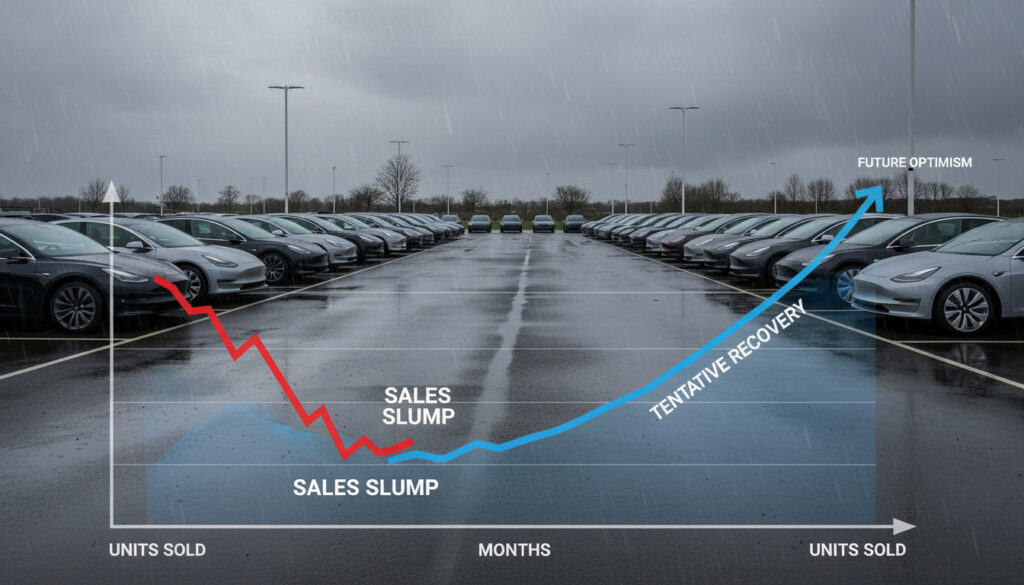
Tesla UK Sales Slump – Figures, Causes and Recovery Outlook
Tesla’s dominance in the UK electric vehicle market has encountered significant headwinds throughout 2024, with registration data revealing a steep decline in sales even as the broader automotive sector experiences renewed growth. The California-based manufacturer’s struggles reflect a complex intersection of intensifying competition, product cycle challenges, and shifting consumer preferences that have collectively eroded its previously unassailable market position.
February 2024 marked a particularly concerning milestone for the brand, with official figures showing a 37% year-on-year drop in UK registrations at a time when total new car sales reached their highest February volume in two decades. This contraction has fueled debate about whether Tesla faces temporary logistical challenges or deeper structural difficulties in maintaining its competitive edge against rapidly maturing rivals.
What Are the Latest Tesla UK Sales Figures?
- UK registrations fell to 2,422 units in February 2024, down from 3,852 in February 2023, according to SMMT data.
- Tesla’s European battery electric vehicle market share has contracted from 18.2% in 2023 to a projected 8.9% in 2025, per Statista analysis.
- The UK market overall grew 7.2% during the same period, highlighting Tesla’s underperformance against the trend.
- Chinese manufacturer BYD recorded an 83% sales increase in the UK during February 2024, though from a lower base.
- Tesla has disputed monthly figures, citing delivery logistics from factories as distorting true demand levels.
- European-wide data shows Tesla sales declining 28% in the first eleven months of 2025 while overall EV sales rose 27%.
- Model Y registrations have declined as part of the broader fleet aging trend.
| Metric | 2023/Early 2024 | 2024/2025 Period | Change |
|---|---|---|---|
| UK Feb Registrations | 3,852 units | 2,422 units | -37% |
| European BEV Market Share | 18.2% | 8.9% (2025) | -9.3 pp |
| EU Sales Trend (11 months) | Baseline 2023 | -40% | Decline |
| Overall UK Market (Feb) | 84,054 units | 90,100 units | +7.2% |
| BYD UK Growth (Feb) | Baseline | +83% | Surge |
| Europe EV Market Growth | Baseline | +27% | Expansion |
Why Have Tesla Sales Slumped in the UK?
Multiple converging factors have driven Tesla’s UK sales decline, extending beyond typical market fluctuations to encompass competitive, product-specific, and geopolitical dimensions. Understanding these drivers requires examining both internal strategic decisions and external market pressures that have reshaped the electric vehicle landscape.
Pressure from Chinese Manufacturers
Chinese brands have emerged as formidable competitors in the UK market, with BYD posting an 83% sales increase in February 2024 despite starting from lower volumes. MG and other entrants have capitalized on aggressive pricing strategies and rapidly improving technology, capturing segments that Tesla previously dominated. The competitive intensity has forced Tesla to confront rivals capable of undercutting prices while offering comparable range and feature sets.
Product Cycle Challenges
Tesla’s current lineup faces criticism for aging designs relative to newer market entrants. The Model 3 and Model Y, while technologically competent, have remained visually and functionally similar for extended periods without significant refreshes that consumers increasingly expect. European automotive data indicates Tesla has underperformed the broader market in seven of the past eight quarters, partially attributable to this product stagnation amid rapid competitor innovation.
EU tariffs on Chinese-manufactured vehicles have affected Tesla’s Shanghai-built units imported to Europe, though interestingly, BYD has maintained growth despite facing higher tariff rates, suggesting brand-specific demand issues beyond pure pricing disadvantages.
Brand Reputation and Political Associations
Elon Musk’s high-profile political activities have generated reputational challenges in European markets, with reports of protests and organized boycotts affecting consumer perception. This phenomenon has proven particularly pronounced in progressive-leaning EV demographics, creating headwinds that purely product-focused competitors have avoided.
Tesla has publicly contested monthly registration figures, arguing that UK delivery scheduling from international factories creates artificial volatility. The company notes that January-February 2024 orders actually exceeded prior years, though fulfillment delays meant registrations appeared lower.
How Do Tesla UK Sales Compare to Competitors and Europe?
The UK decline mirrors broader European trends, though specific regional factors amplify the challenges Tesla faces in maintaining its historical market leadership. Comparative analysis reveals a consistent pattern of market share erosion across multiple jurisdictions.
European Market Context
European data through 2025 shows Tesla’s sales declining 28% across the continent (including EU, Norway, Switzerland, Iceland, and UK) during the first eleven months, with the EU alone experiencing a steeper 40% drop. This contrasts sharply with the 27% growth in overall European EV sales during the same timeframe, indicating Tesla-specific difficulties rather than sector-wide contraction.
UK Competitive Landscape
While Tesla maintains volume advantages over individual Chinese brands in absolute terms, the trajectory favors newer entrants. The UK market’s robust recovery in private retail sales has benefited competitors more than Tesla, suggesting the brand has lost its first-mover advantage as mainstream consumers explore alternatives. Legacy European manufacturers expanding their EV portfolios have further fragmented a market Tesla once dominated. As consumers evaluate total cost of ownership, routine maintenance factors such as When Should Tyre Pressure Be Checked become part of the comparison between Tesla and traditional vehicles.
What Is Tesla’s Outlook for UK Sales Recovery?
Prospects for near-term recovery remain uncertain, with available data through 2025 showing persistent weakness in European market share and no definitive catalysts for immediate reversal of negative trends.
Short-Term Uncertainties
Specific Q3 2024 UK figures remain unavailable in current datasets, though global Q3 deliveries received temporary boosts from expiring subsidies in the US and Turkey, potentially creating demand cliffs in subsequent quarters. Overseas sales represented 62% of Tesla’s total in late 2024, but European weakness suggests regional strategies require recalibration. Much like how motorsport enthusiasts anticipate the Sky Sports F1 Schedule for seasonal planning, Tesla’s UK delivery schedules follow batch patterns that affect monthly registration timing.
Strategic Responses
Tesla continues emphasizing quarterly rather than monthly metrics to contextualize UK performance, arguing that shipment batching from California and Shanghai factories distorts monthly registration data. The company has not publicly outlined specific UK recovery initiatives beyond general references to production scaling and potential future model introductions.
While overseas sales showed positivity into late 2024, the UK and broader European market trends indicate region-specific challenges that global aggregate figures may obscure.
When Did Tesla’s UK Sales Start Declining?
- : Tesla maintains 18.2% European BEV market share, representing peak performance levels.
- : Early signs of UK order fulfillment issues emerge, with unfulfilled orders exceeding prior years.
- : UK registrations plummet 37% year-on-year to 2,422 units amid surging total market growth.
- : Broader European decline accelerates, with Tesla underperforming market growth in seven of eight recent quarters.
- : Market share continues eroding to 16.6% then 8.9%, with EU sales dropping 40%.
What Is Confirmed Versus Uncertain About Tesla’s UK Performance?
Established Facts
- SMMT data confirms 37% UK registration drop in February 2024
- European market share declined from 18.2% to 8.9% between 2023-2025
- BYD achieved 83% growth in UK February 2024 sales
- Overall UK car market grew 7.2% in February 2024
- Tesla cites delivery logistics as distorting monthly UK figures
Remaining Uncertainties
- Specific Q3 2024 UK registration figures
- Exact timeline for Model Y or Model 3 refresh impacts
- Quantifiable impact of Musk’s political activities on UK sales specifically
- Recovery trajectory for 2025 and beyond
- Precise comparative data for MG and other Chinese brands in UK
How Does Tesla’s Slump Reflect Broader UK EV Market Dynamics?
The UK electric vehicle sector has demonstrated remarkable resilience and growth in 2024, with February recording the strongest monthly performance for that period since 2004. This expansion has occurred alongside Tesla’s decline, indicating market maturation where early adopters’ brand loyalties are giving way to pragmatic comparisons of value, features, and availability. The influx of competitively priced Chinese alternatives has democratized EV access, while legacy manufacturers’ electrification efforts have provided mainstream consumers with familiar brands offering zero-emission options.
Government policy and infrastructure development continue supporting EV adoption broadly, meaning Tesla’s challenges stem primarily from competitive positioning rather than sectoral contraction. The divergence between Tesla’s performance and overall market health suggests the UK has entered a new phase of EV adoption where first-mover advantages have dissipated and sustained product competitiveness determines market share.
Who Is Reporting on Tesla’s UK Sales Decline?
“Tesla’s UK registrations in February 2024 plummeted 37% from 3,852 units in February 2023 to 2,422 units, while total new car sales rose 7.2% to 90,100 units—the strongest February since 2004.”
— Society of Motor Manufacturers and Traders (SMMT)
“Tesla’s European BEV market share eroded from 18.2% in 2023 to 16.6% in 2024 and 8.9% in 2025, underperforming the market in seven of eight recent quarters amid an aging fleet.”
— Statista Market Analysis
“January-February 2024 orders exceeded prior years but were unfulfilled due to delivery logistics from factories.”
— Tesla Official Response
What Should UK Consumers and Investors Understand About Tesla’s Sales Slump?
Tesla’s UK sales slump represents a significant market correction driven by intensifying competition from Chinese manufacturers like BYD, product cycle limitations, and complex reputational factors. While the company disputes monthly data interpretations citing logistical complexities, the broader European trend of declining market share and underperformance against growing EV adoption suggests structural challenges requiring strategic response. For consumers, the shift creates expanded choices and competitive pricing, while When Should Tyre Pressure Be Checked remains an essential consideration for all EV ownership regardless of brand selection. The coming quarters will determine whether Tesla’s anticipated model refreshes and adjusted logistics can reverse the current trajectory in an increasingly crowded market.
Frequently Asked Questions
How has the Cybertruck launch affected UK sales?
The Cybertruck is not currently available in the UK market due to regulatory and design specifications, so it has had no direct impact on 2024 UK sales figures. The model’s absence leaves a gap in Tesla’s UK commercial vehicle offerings.
What is Tesla doing to reverse the UK sales slump?
Tesla has emphasized that monthly registration data misrepresents actual demand due to batch delivery schedules from international factories. The company recommends evaluating quarterly figures for accurate assessment but has not announced specific UK market recovery initiatives.
Are Tesla’s UK sales dropping faster than in Europe?
The UK February 2024 decline of 37% aligns with broader European trends showing 28-40% drops in various regions. Tesla’s underperformance appears consistent across European markets rather than UK-specific.
How do Tesla’s prices compare to BYD in the UK?
While specific pricing comparisons vary by model configuration, BYD has gained traction through competitive pricing strategies. Tesla faces additional pressure from EU tariffs on its Shanghai-manufactured vehicles, though BYD operates under similar tariff constraints.
Will Tesla release new models to boost UK sales?
Tesla has indicated potential model refreshes but has not confirmed specific UK launch timelines. The current aging lineup contributes to competitive pressure from newer entrants with updated features and designs.
Is the UK EV market shrinking overall?
No. The UK EV market grew significantly in 2024, with February recording the strongest monthly sales since 2004. Tesla’s decline contrasts with overall sector expansion.
How reliable are monthly SMMT registration figures?
SMMT data represents official government registrations and is considered authoritative. However, Tesla argues these figures reflect delivery timing rather than order demand due to international shipping logistics.
More related posts
 Dame Kelly Holmes: Biography, Net Worth, Army Rank, Relationship, and Health
 Roger Moore: Cause of Death, Bond Films, and Why He Quit
 800 Euros in Pounds – Current Rate and Conversion Guide
 Greg Hemphill: Biography, Net Worth, and Ford Kiernan Fallout
 Jimmy Savile: Verified Facts and Official Reports
 London School of Economics: Rankings, Admissions & Fees
 Roman Numerals 1-100 – Complete Chart and Guide
 Les Wexner: biography, net worth, Epstein scandal, and companies