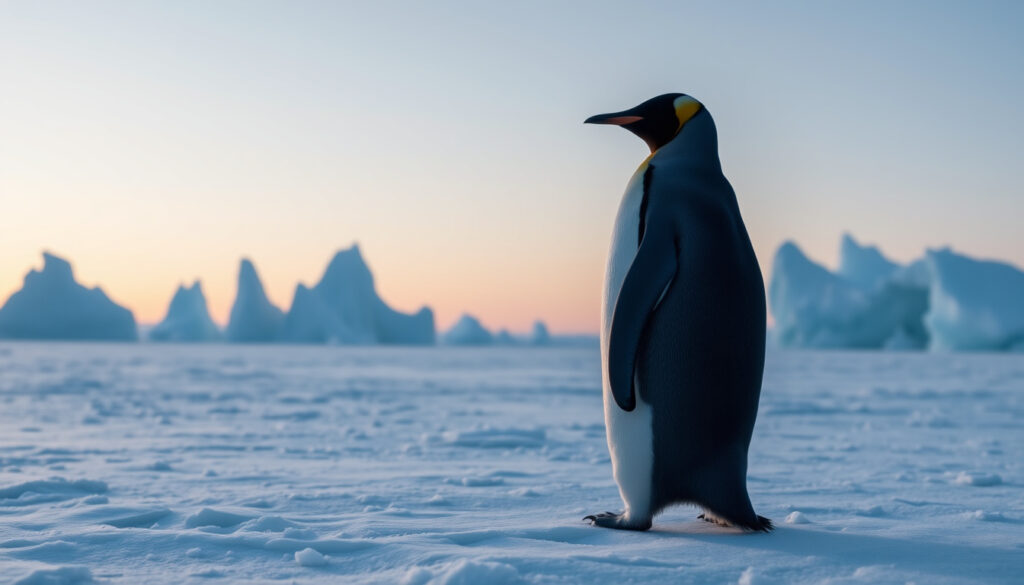
Emperor Penguin Facts: Size, Extinction, and Survival
There’s something almost unbelievable about a bird that chooses to raise its young during the darkest, coldest months on Earth — the emperor penguin doesn’t just endure the Antarctic winter, it depends on it. This extraordinary species was reclassified as Endangered in 2026, and its survival is now tied to the fate of sea ice.
Height: Up to 125 cm (4.1 ft) ·
Weight: 22–45 kg (49–99 lb) ·
Lifespan: Up to 20 years in the wild ·
IUCN Status: Endangered (2026) ·
Estimated Breeding Pairs: Approximately 238,000
Quick snapshot
- Largest penguin species, standing up to 125 cm (Britannica (encyclopedia))
- Breeds exclusively on Antarctic sea ice (WWF-UK (wildlife charity))
- IUCN status changed to Endangered in 2026 (Oceanographic Magazine (science publication))
- Exact global population size — current estimates around 238,000 breeding pairs (Antarctic and Southern Ocean Coalition (conservation group))
- Whether emperor penguins can adapt to completely ice-free conditions (Antarctic and Southern Ocean Coalition (conservation group))
- 2026: IUCN reclassifies from Near Threatened to Endangered (Oceanographic Magazine (science publication))
- Projected population declines up to 99% by 2100 if emissions continue (The New York Times (major newspaper))
Seven key specs, one pattern: the emperor penguin is built for extremes, from its towering stature to its marathon incubation cycle.
| Attribute | Value |
|---|---|
| Scientific Name | Aptenodytes forsteri |
| Average Height | 122–125 cm |
| Average Weight | 22–45 kg |
| Lifespan | Up to 20 years |
| Breeding Season | April to December (Antarctic winter) |
| Incubation Period | 65–75 days |
| IUCN Status (2026) | Endangered |
What is special about emperor penguins?
Emperor penguins (Aptenodytes forsteri) are the largest of all penguin species, standing up to 125 cm tall and weighing 22–45 kg (Britannica (encyclopedia)). But size alone doesn’t explain their fame. They are the only penguins that breed during the Antarctic winter, laying eggs in April and incubating them through months of darkness and temperatures that can drop below −50 °C.
What is a sad fact about penguins?
Perhaps the most sobering fact is that emperor penguins now face extinction largely because of climate change. The same sea ice they rely on for breeding is shrinking rapidly. In parts of the Antarctic Peninsula, sea ice coverage has declined by over 60% in 30 years (Woods Hole Oceanographic Institution (ocean research institute)).
How do emperor penguins survive the Antarctic winter?
Their survival toolkit is extraordinary. A dense double layer of feathers traps heat, and they can ‘recycle’ body heat through a counter-current heat exchange system (Australian Antarctic Program (government science agency)). They also huddle together in tightly packed groups of up to several thousand birds, each individual taking turns in the warmer centre before rotating outward.
The same huddling behaviour that keeps them alive through winter also makes them vulnerable: when sea ice breaks up early, colonies can collapse because there is no stable platform for huddling.
The implication: emperor penguins have evolved to thrive in one of the harshest environments on Earth, but that very adaptation locks them into dependence on sea ice.
Which penguin is bigger, king or emperor?
Size is the simplest way to tell them apart. Emperor penguins are taller and heavier than king penguins, which are the second largest species. Adults stand up to 125 cm, while king penguins reach about 95 cm (Britannica (encyclopedia)). Weight differences are even more pronounced: emperors can hit 45 kg, whereas kings top out around 16 kg.
What are the size differences between king and emperor penguins?
Two birds, one key contrast — here’s a side-by-side comparison.
| Trait | Emperor Penguin | King Penguin |
|---|---|---|
| Height | Up to 125 cm | Up to 95 cm |
| Weight | 22–45 kg | 11–16 kg |
| Breeding location | Antarctic sea ice | Sub-Antarctic islands (bare ground) |
| Incubation period | 65–75 days | 54 days |
| IUCN status (2026) | Endangered | Least Concern |
Why this matters: the two species occupy very different ecological niches. King penguins breed on land and are not tied to sea ice, which is why their conservation outlook is far less dire.
Why are emperor penguins going extinct?
The primary driver is loss of sea ice habitat due to global warming. Emperor penguins depend on stable sea ice from April through December to lay eggs and raise chicks. When that ice breaks up early, chicks can drown or freeze before they develop waterproof feathers (WWF-UK (wildlife charity)). The IUCN reclassified the species from Near Threatened to Endangered in 2026, a move that Oceanographic Magazine (science publication) described as a stark signal of climate change’s impact on Antarctic wildlife.
What animals will not exist in 2050?
While no one can predict extinction dates with certainty, scientists project that emperor penguin populations could decline by up to 99% by 2100 under current emissions scenarios (The New York Times (major newspaper)). Alongside emperor penguins, Antarctic fur seals were also uplisted to Endangered in 2026 (Oceanographic Magazine (science publication)).
How does climate change affect emperor penguins?
It attacks the foundation of their breeding cycle. Sea ice coverage in the Antarctic Peninsula has dropped by over 60% in three decades (Woods Hole Oceanographic Institution (ocean research institute)). The Ross Sea and Weddell Sea remain strongholds, but even there, ice variability is increasing (U.S. Fish and Wildlife Service (federal wildlife agency)).
The U.S. Fish and Wildlife Service already granted emperor penguins Endangered Species Act protections in 2022 (U.S. Fish and Wildlife Service (federal wildlife agency)). That policy won’t matter if sea ice continues to disappear.
The pattern: emperor penguins are caught in a feedback loop — warming melts ice, ice loss reduces breeding success, fewer chicks translate to rapid population decline.
Are emperor penguins friendly?
Emperor penguins are not aggressive toward humans, but they are not exactly friendly in the way a dog or a domestic animal is. They are cautious wild birds. However, they are also curious — researchers report that individuals sometimes approach people on the ice (Australian Antarctic Program (government science agency)). Because they have no land predators in Antarctica, they have not evolved a strong fear response.
Which penguin is the friendliest?
Among penguin species, gentoo and chinstrap penguins are often described as the most tolerant of human presence. Emperor penguins keep more distance and are generally considered less sociable than smaller species.
The catch: “friendly” is a human label. Emperor penguins are simply not territorial — a rare trait among penguins (Australian Antarctic Program (government science agency)). That makes them appear approachable, but they remain wild animals that should be observed from a respectful distance.
What is a sad fact about penguins?
All penguins face growing threats, but emperor penguins are among the most vulnerable because of their total dependence on sea ice. Beyond climate change, pollution and overfishing of krill — a primary food source — add pressure (WWF-UK (wildlife charity)). Yet the species has survived for millennia, huddling through the worst winter on the planet.
What is the only bird that can’t fly but can swim?
Emperor penguins are flightless birds that are supremely adapted to water. They can dive deeper than 500 metres and hold their breath for over 20 minutes (Australian Antarctic Program (government science agency)). Their solid bones reduce buoyancy, and their flippers act like powerful wings through the water.
The implication: emperor penguins represent a flagship species for understanding climate change impacts on Antarctic wildlife.
Timeline: emperor penguin conservation milestones
- 1844 – Species first described by naturalists. (Wikipedia (encyclopedia))
- 1950s–1960s – Early population surveys begin. (Wikipedia (encyclopedia))
- 2010s – Studies document significant sea ice decline in breeding habitat. (Wikipedia (encyclopedia))
- 2022 – U.S. Fish and Wildlife Service proposes Endangered Species Act protections (U.S. Fish and Wildlife Service (federal wildlife agency)).
- 2026 – IUCN reclassifies emperor penguin from Near Threatened to Endangered (The New York Times (major newspaper)).
The trend is clear: each milestone marks a step deeper into conservation concern as sea ice declines.
Clarity check
Confirmed facts
- Emperor penguin is the tallest penguin species (Britannica (encyclopedia))
- They breed exclusively on Antarctic sea ice (WWF-UK (wildlife charity))
- IUCN status changed to Endangered in 2026 (The New York Times (major newspaper))
- Climate change reduces sea ice extent (Woods Hole Oceanographic Institution (ocean research institute))
What’s unclear
- Exact global population size — current estimates around 238,000 breeding pairs (Antarctic and Southern Ocean Coalition (conservation group))
- Whether emperor penguins can adapt to completely ice-free conditions
- Future rate of population decline under different emission scenarios
The balance of evidence leans heavily toward a grim future unless emissions are curbed.
Quotes from the experts
Emperor penguins have officially been moved to ‘Endangered’ on the IUCN Red List. Without urgent action, colonies could face catastrophic losses.
— WWF (WWF-UK (wildlife charity))
Emperor penguins are amazing birds. They not only survive the Antarctic winter, but they breed during the worst weather conditions on earth.
— Australian Antarctic Program (Australian Antarctic Program (government science agency))
Together, these perspectives underscore the urgency of protecting sea ice habitat to ensure the emperor penguin’s survival.
The verdict is clear: emperor penguins are one of the planet’s most resilient animals, but even their extreme adaptations cannot outrun the pace of sea ice loss. For anyone concerned about biodiversity, the choice is simple — cut emissions to preserve the ice, or watch the colonies disappear from Antarctica’s coast.
Related reading: Normal Blood Pressure by Age: Chart for Women and Men · DNA Tests: Accuracy, Cost, Ancestry & Medical Guide in Ireland
pmc.ncbi.nlm.nih.gov, facebook.com, blogpatagonia.australis.com, norskbetting.info
For a deeper look at their habitat and the threats they face, see this detailed overview of emperor penguin facts and habitat.
Frequently asked questions
How do emperor penguins find food?
They dive up to 500 metres deep, using their exceptional vision to catch fish, krill, and squid. They can hold their breath for over 20 minutes (Australian Antarctic Program (government science agency)).
How long do emperor penguins incubate their eggs?
The incubation period is 65–75 days. The male balances the egg on his feet, covered by a brood pouch, for about two months while the female feeds at sea.
Do emperor penguins mate for life?
They are serially monogamous — pairs form each breeding season, but they often choose a different mate the following year.
What is the scientific name of the emperor penguin?
Aptenodytes forsteri.
How many emperor penguins are left in the wild?
Current estimates suggest around 238,000 breeding pairs, though exact numbers are uncertain (Antarctic and Southern Ocean Coalition (conservation group)).
Can emperor penguins survive in zoos?
Very few zoos have successfully kept emperor penguins because they require Antarctic-like conditions. Most captive penguins are smaller species such as gentoo or king penguins.
Why do emperor penguins huddle together?
Huddling reduces heat loss by up to 50%. Birds on the cold outer edge rotate toward the centre, sharing warmth in a coordinated group movement.
More related posts
 DNA Tests: Accuracy, Cost, Ancestry & Medical Guide in Ireland
 Michael J. Fox Parkinson’s: Stage, Life Expectancy & Updates
 Brandon Williams: Career, Crash Rumors, and Hull City Exit
 Roger Moore: Cause of Death, Bond Films, and Why He Quit
 Worcester Bosch Combi Boiler – Best Models and Prices 2025
 Kai Havertz: Height, Stats, Age, Wife, and Career Facts
 Manon Katseye Hiatus: Facts, Timeline & Official Updates
 Hugo Ekitike: Biography, Stats, Transfer & Personal Life