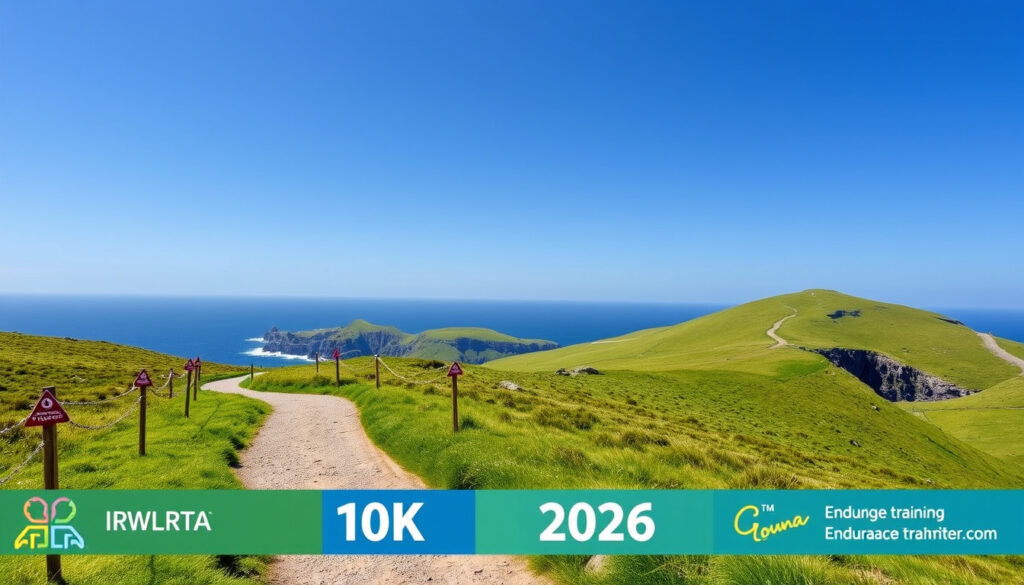
10K Runs Near Me: Ireland 2026 Races & Training Guide
If you’ve been building up from 5K and are wondering whether this is the right next step, you’re in the right place. Ireland hosts dozens of 10K events each year, from trail runs along the Cliffs of Moher to flat urban sprints through Dublin’s Phoenix Park. This guide covers the key 2026 race calendar, breaks down what constitutes a good finishing time, and lays out a training schedule you can adapt to your current fitness level.
Distance: 10 kilometers · Popular in Ireland: Dublin, Cork, Limerick · Event types: 5K/10K combos, charity runs · Calendars: runningcalendar.ie, popupraces.ie · Average beginner time: 60-70 minutes
Quick snapshot
- 10K equals 10 kilometers (6.2 miles) — standard race distance from athletics governing bodies
- Great Ireland Run set for April 12, 2026 in Phoenix Park, Dublin (Great Ireland Run)
- Irish Runner 10 Mile entry fee is €33 (Athletics Ireland)
- Exact dates for some multi-distance events like Portumna Forest and Waterford Viking Marathon
- Full entry fees and capacity limits for most regional races
- Events scheduled after October 2026 remain sparse in current sources
- February–April 2026: Cluster of early-season races across Clare, Dublin, and Wexford (regional race calendar from JustRace)
- May 2026: Great Limerick Run, Run Killarney, Maynooth 10K (national race listings from Ahotu)
- October 2026: Gaelforce 10K Howth rounds out the calendar (trail race listings from Running Calendar IE)
- Check runningcalendar.ie for updated registration links as race dates approach
- Book accommodation early for popular events like the Great Ireland Run
- Consider cross-training and rest days built into your schedule
These dates represent key events drawn from Irish race calendars and event organizers.
| Label | Value |
|---|---|
| 10K Distance | 10 km (6.2 miles) |
| Key Sites | runningcalendar.ie, popupraces.ie |
| Ireland Focus | Dublin, Cork, Limerick events |
| Great Ireland Run 2026 | April 12, Phoenix Park, Dublin |
| Irish Runner 5K Series | Starts May 16, 2026, Phoenix Park |
| Great Limerick Run | May 3, 2026, Limerick |
| RunClare 10km | March 21, 2026, Ennis, Co. Clare |
| Inis Oírr Wild Atlantic Island Run | April 18, 2026, Inisheer, Co. Galway |
| Irish Runner 10 Mile Entry Fee | €33 (excluding fees) |
| Gaelforce 10K Howth | October 10, 2026, Howth, Co. Dublin |
What is the average time for a 10km run?
Most recreational runners finish a 10K in 50–70 minutes, which translates to roughly 5–7 minutes per kilometer. Elite athletes like Mo Farah complete the distance in under 27 minutes, according to Wikipedia, but that pace is far beyond what weekend park runners typically target.
Factors affecting average times
Terrain makes a significant difference. A flat course through Phoenix Park will typically yield faster times than a trail run with elevation, such as the Bray Gaelforce 10k with its 2km climb along clifftops, as documented by Red Bull. Weather conditions, your training background, and whether you’re running solo or in a race environment with crowd support all factor into your final time.
Beginner vs elite benchmarks
If you’re new to running, aiming for a finish between 60–70 minutes is realistic with consistent training. Experienced runners targeting personal bests often look to break 50 minutes. The Irish Runner 10 Mile event, which shares the 10K demographic, has an entry fee of €33, according to Athletics Ireland, the official governing body for athletics in Ireland.
Your ideal pace depends on the course profile. Enter flatter events like the Great Ireland Run if you’re chasing a PB, and save the coastal trails for a scenic challenge instead.
What is a good time for a 10k?
Sub-50 minutes is considered a strong time for amateur runners. Breaking one hour puts you in the upper half of most recreational race fields. These benchmarks help you set realistic goals before you register for an event.
Pacing tips for different levels
For beginners, start conservatively—the excitement of race day often leads to going out too fast. Aim to negative split (running the second half faster than the first). Intermediate runners benefit from tempo runs during training, where you sustain a comfortably hard pace for 20–30 minutes. Advanced runners targeting sub-45 minutes need interval training at threshold pace.
Training benchmarks
A typical progression might look like this: build your weekly mileage to 30–40 km over 8–12 weeks, incorporate one long run of 8–10 km on weekends, and add a weekly speed session. The Great Limerick Run on May 3, 2026 is a good target race for this type of structured build, according to Finishers.
Without a target pace in training, you’re unlikely to surprise yourself on race day. A structured plan prevents both undertraining and overtraining, which is the most common reason runners bonk before the finish.
How many days a week should you run for a 10K?
Three to four running days per week works well for most people training for a 10K. This frequency allows adequate recovery while building the aerobic base needed to cover 10 kilometers comfortably.
Beginner schedule
Start with three runs per week: one short session of 3–4 km, one medium run of 5–6 km, and one long run of 7–8 km. Fill the remaining days with walking, cycling, or rest. The RunClare 10km on March 21, 2026 in Ennis, Co. Clare is an accessible early-season target, as noted by JustRace, a specialist events organizer for Munster and Clare.
Build-up plan
Over 8–12 weeks, gradually increase your long run by 1 km each week until you can comfortably cover 10 km in training. Do not increase total weekly mileage by more than 10% week-over-week. Rest days are not optional—they’re when your muscles repair and adapt to the training stimulus.
How far is a 10K run for beginners?
A 10K is 10 kilometers, which equals 6.2 miles. If you’ve already completed a 5K (3.1 miles), you’re halfway there in terms of distance—the challenge is sustaining that effort for twice the time.
Distance in miles
6.2 miles sounds more manageable when you break it down: roughly 62 football fields in length, or about 125 laps of a standard athletics track. Most beginners discover that the mental challenge of staying focused for that duration is harder than the physical demand.
First-timer tips
Walk the water stations on race day to understand the course layout. Practice fueling with water and energy gels during your long training runs, not for the first time on race morning. The Inis Oírr Wild Atlantic Island Run on April 18, 2026 offers a unique island setting that can make the distance feel less intimidating than an urban loop, according to Running Calendar IE.
The real risk lies in treating the jump from 5K to 10K as a simple doubling of training volume—your longest run in preparation should reach at least 8 km, because running 10K on race day without having covered that distance in training increases injury risk significantly.
Upcoming 10K runs near me
The 2026 Irish race calendar is already taking shape, with events clustered in spring and early summer. County Clare alone hosts at least four 10K events between March and April, making it one of the densest regions for races in the country, per JustRace.
Ireland 2026 events
Key dates to mark: RunClare 10km on March 21, 2026; The Great Ennis 10K on March 29, 2026; and the Great Ireland Run on April 12, 2026 in Phoenix Park, Dublin—the latter organized by Dublin City Harriers and Athletics Ireland. Later in the year, Gaelforce 10K Howth on October 10, 2026 offers a trail running alternative with coastal scenery, according to Running Calendar IE.
This weekend options
If you’re looking for spontaneous race opportunities, check runningcalendar.ie and popupraces.ie regularly. Both platforms aggregate events including smaller community races that don’t make national headlines. The Life Style Sports Dundalk Half Marathon & 10k on February 1, 2026 is one early-season option, per Ahotu, an international race aggregator.
Ireland offers more 10K options per capita than most countries in Europe. The challenge is not finding a race—it’s picking one that matches your ability and goals, then committing to a training schedule that gets you to the start line ready.
Training plan for your first 10K
This 10-week plan assumes you’re currently running 2–3 times per week and can cover 3–4 km without stopping. If you’re starting from scratch, add a 4-week base-building phase before week one.
- Week 1–2: Run three times per week. Longest run: 5 km. Include one session where you run 1 minute faster than easy pace, then walk for 1 minute. Repeat four times.
- Week 3–4: Add a fourth short run (2–3 km). Longest run climbs to 6 km. Introduce one hillier route on your medium run.
- Week 5–6: Longest run reaches 7 km. Your speed session becomes 5 × 800 meters at 10K race pace with 90-second recoveries.
- Week 7–8: Longest run hits 8–9 km. This is where consistency matters most—do not skip rest days.
- Week 9: Begin tapering. Longest run drops to 6 km, but maintain pace intensity.
- Week 10: Race week. Run easy for 20 minutes on Tuesday or Wednesday. Rest fully 48 hours before race day.
What the experts say
This year, take on the 10k distance and #BeYourGreatest!
— Great Ireland Run organizers (Event Promoter)
A super accessible run for race newbies, this 10km route starts at the Belmont Estate with a run towards the fringes of a mountain requiring a 2km climb.
— Red Bull Editors (Race Reviewers)
Confirmed vs unclear
Confirmed
- 10K = 10 km standard distance
- Great Ireland Run confirmed for April 12, 2026, Phoenix Park
- Multiple Clare region races confirmed in March–April 2026
- Athletics Ireland organizes the Irish Runner series
Unclear
- Exact dates for Portumna Forest Marathon 10K option
- Specific dates for Waterford Viking Marathon 10K
- Full entry fees and capacity limits for most regional races
- Events scheduled after October 2026
For Irish runners ready to move beyond 5K, the 2026 calendar offers accessible entry points across every province. The Great Ireland Run remains the flagship national event, but regional organizers like JustRace have filled the calendar with options that require no travel to Dublin.
Is a 10K harder than a 5K?
Yes, but not exponentially. A 10K requires roughly twice the time on your feet compared to a 5K. The mental challenge of sustaining effort for 50–70 minutes is the main difference—your body adapts to the distance through training, but your mind needs practice staying focused.
Do people run 10K without stopping?
Most race finishers complete a 10K without walking. Walk breaks are common among beginners in training, but competitive and recreational runners alike typically run the entire distance on race day. Walking through water stations is acceptable and does not disqualify you from a running finish.
Can running 10K a week lose belly fat?
Running 10K per week contributes to a calorie deficit when paired with dietary awareness. Spot reduction is a myth—fat loss occurs systemically. Consistent aerobic exercise at this volume supports overall body composition changes over 8–12 weeks.
How do I register for 10K runs near me?
Visit runningcalendar.ie or popupraces.ie for comprehensive Irish event listings. Most races open registration 3–6 months in advance through the organizer’s website or platforms like EntrEmi in Ireland. Popular events like the Great Ireland Run fill quickly—book as soon as entries open.
What to expect at a 10K race in Ireland?
Expect chip timing, water stations every 2–3 km, and a finishers’ medal. Most Irish events have community-level organization with friendly volunteer staff. Post-race facilities range from tea and bananas at smaller events to full expo areas at the Great Ireland Run.
Are there free 10K runs near me?
Organized free 10K races are rare in Ireland—most events charge €20–€40 to cover permits, timing, and safety services. Parkrun offers free 5K runs every Saturday at locations nationwide, which serve as accessible training benchmarks for runners building toward a 10K.
Best shoes for 10K training?
A reliable daily trainer with 300–500 km of cushioning life works for most runners. If you’re racing on flat roads like Phoenix Park, a lightweight performance shoe complements your rotation. For trail events like Gaelforce 10K Howth, trail shoes with grip soles are essential, per Running Calendar IE.
Related reading: Sky Sports F1 Schedule · Everton F.C. vs Arsenal F.C. Timeline
runningcalendar.ie, bearraces.ie, runningcalendar.ie, gorunningtours.com
While targeting Ireland’s 2026 events in Dublin and Cork, runners often reference the 2025-2026 10K races calendar for broader race planning and pacing insights.
More related posts
 Si Ferry: Bio, Career, Podcast, Net Worth & Personal Life
 Elliot Cowan: Biography, Roles, and Personal Life Facts
 Chloe Burrows: Love Island, ADHD, Relationships, Age, Net Worth
 Meghan Trainor: Health, Family, and Cosmetic Changes
 Ahn Hyo-seop: Bio, Dating, English & Military Exemption
 La Vieille Ferme Rosé – Tasting Notes, Pairings and Value Guide
 Little House on the Prairie: Netflix 2026 Premiere
 Shaun Ryder: Diagnoses, Sobriety, Wife, and Kids